Tier 1 Literacy Playbook
Strong Tier 1 Starts Here.
The best intervention begins before students struggle.
What if one of the most powerful things we could do for struggling readers happened before they ever needed intervention? That’s the idea behind the Reading Rev Tier 1 Structured Literacy Playbook.
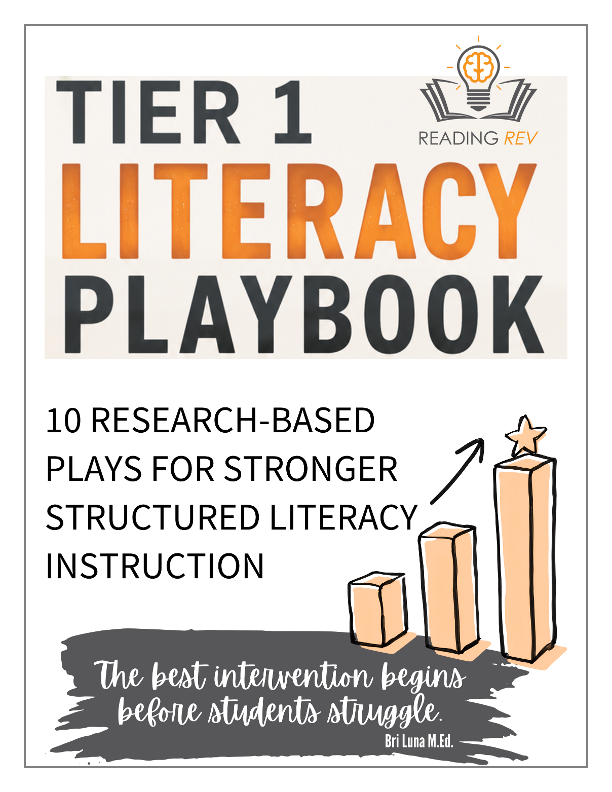
For the next 10 days, we’re going back to the heart of great literacy instruction with 10 practical “plays” to strengthen Tier 1 for ALL learners.
We’ll tackle everything from word recognition, vocabulary, comprehension, and writing to using data, research, and instructional time more intentionally.
And this isn’t a “read the blog and move on” series. Each day, we’ll share practical strategies, free resources, classroom ideas, and some pretty great prizes..
A new play will be added here each day, and at the end, we’ll package the entire Reading Rev Tier 1 Structured Literacy Playbook you can use all year, because strong Tier 1 instruction doesn’t happen by accident. It happens one intentional instructional decision at a time.
Find over 20 evidence-based resources inside!
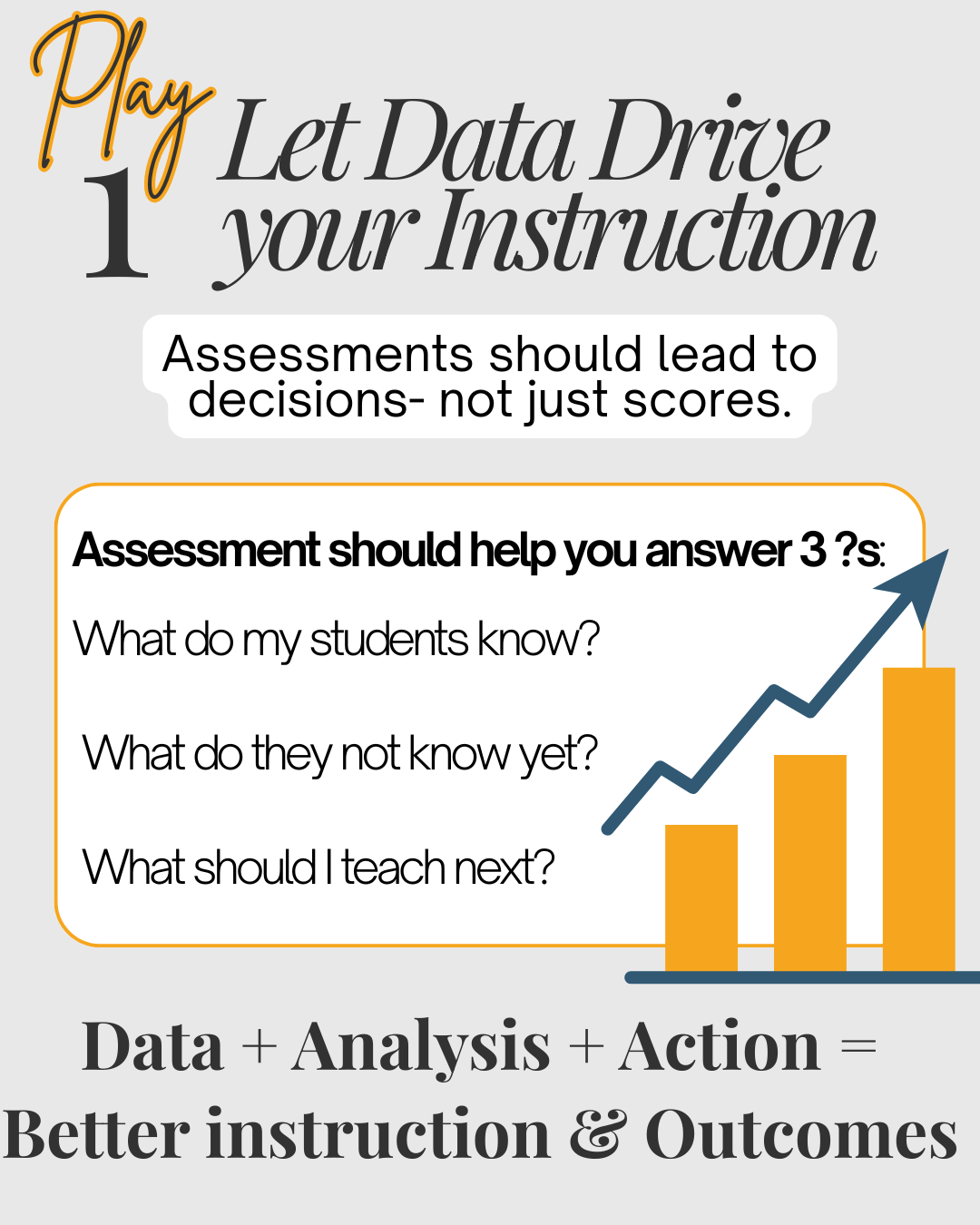
PLAY 1: Data as the Driver
Big Idea
Assessment should help you answer three questions:
What do my students know?
What do they not know yet?
What should I teach next?
If the data doesn’t help you make an instructional decision, ask yourself whether you really need to collect it.
Why It Matters
Effective teachers don't collect more data just for the sake of collecting data. They collect the right data, and then they do something with it.
Frequent, skill-specific assessment helps you pinpoint exactly where students are succeeding and where instruction needs to go next. When we identify and respond to gaps early, we have a much better chance of preventing small gaps from becoming big ones.
Try This Tomorrow
Beginning-of-the-year assessment can feel overwhelming. The temptation is to give the assessments, record the scores, check the box, and move on.
Instead, choose one assessment you've already given and look at it through an instructional lens. Don't just look at the score. Ask:
What does this student already know?
Where specifically did the student break down?
Do I see a pattern across several students?
What will I teach differently because of what I learned?
That last question is the most important one.
Data + Analysis + Action = Better Instruction and Outcomes
Need Help Making Sense of Your Data?
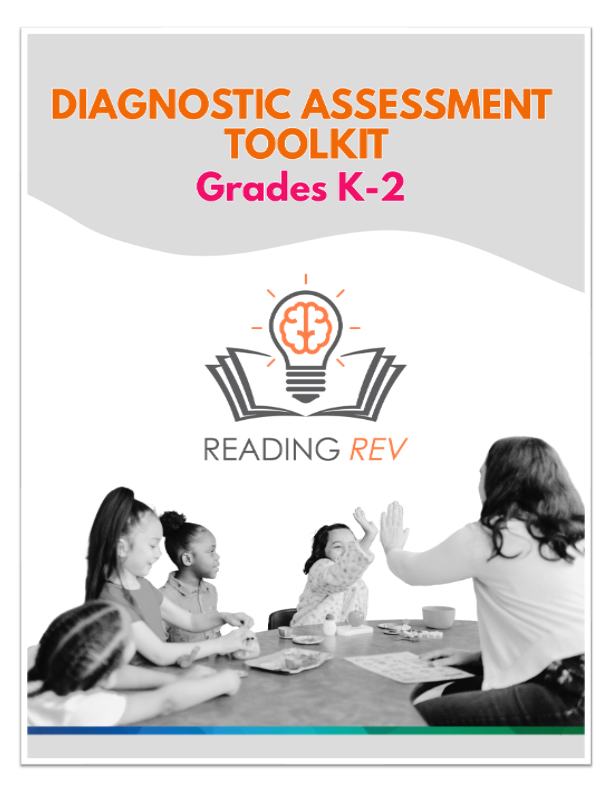
We teamed up with the Georgia Department of Education to create two Diagnostic Assessment Toolkits: K–2 and Grades 3–8.
These toolkits walk you through the entire process: which assessments to give, how to administer them, how to analyze and interpret the results, and…most importantly, what to do next.
Because the goal isn't to assess more. The goal is to know more so you can teach better.
Favorite Resource(s)
Reading Rev Diagnostic Assessment Toolkits (linked in Playbook)
Research Corner
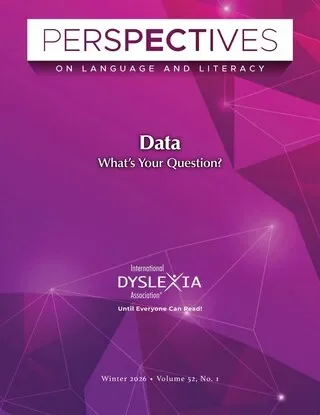
International Dyslexia Association Perspectives on Language & Literacy: Data. What’s your Question?
The International Dyslexia Association’s Perspectives on Language and Literacy connects current literacy research with classroom practice, bringing together experts to explore important topics in dyslexia, assessment, and instruction and translate research into actionable guidance for educators. The Winter 2026 issue is all about making data manageable and useful! These publications are free for IDA members!
Play 2: Rooted in Research
Big Idea
It’s not just about what you teach. It’s about teaching in ways that help students actually LEARN.
We have decades of research about how students learn best. Strong Tier 1 instruction puts that research into action.
Why it Matters
Teachers are constantly being introduced to new programs, strategies, acronyms, and initiatives. But new doesn't necessarily mean better.
Instead of chasing the next new thing, start with what research tells us works.
Evidence-based instructional practices can help us increase engagement, deepen thinking, strengthen comprehension, and give every student more opportunities to actively participate in learning.
And here's the important part: research only changes outcomes when it changes what happens in the classroom.
That’s exactly why we created our Rooted in Research series.
Try This Tomorrow
Choose ONE research-based strategy and intentionally build it into a lesson you are already teaching. You don't need to redesign your curriculum or add another thing to your plate.
Try Elevated Academic Talk instead of a basic Turn & Talk, PALS for structured partner reading, or Reciprocal Teaching to get students actively predicting, questioning, clarifying, and summarizing.
One strategy. One lesson. One intentional instructional shift.
That's how research becomes practice.
Favorite Resources: So far, we've created guides for these evidence-base strategies.
Collaborative Strategic Reading (CSR)
Elevated Academic Talk
Knowledge Acquisition & Transformation (KAT)
Peer-Assisted Learning Strategies (PALS)
Reciprocal Teaching
And we're just getting started!
Reading Rev VIP members will get new Rooted in Research guides added to the VIP Vault throughout the school year, so your collection of evidence-based, classroom-ready strategies will keep growing. Check out our series and these 5 guides for free here!
Play 3: KNOW your students… Beyond the Plan
Big Idea:
Students are more than their reading level, test scores, behaviors, diagnoses, IEPs, or 504 plans.
Great instruction begins with knowing who is sitting in front of you. Not just their data, but their strengths, interests, experiences, preferences, challenges, and what helps them feel successful.
This mindset shift changes the lens from What's wrong? to What can I build on? or How can I engage this student for optimal learning?
Why It Matters
Relationships aren't something we build alongside teaching. Relationships make teaching more effective.
A major meta-analysis of 99 studies from preschool through high school found that the quality of teacher-student relationships was associated with both student engagement and academic achievement, with particularly strong associations with engagement. (Roorda et al., 2011)
And this isn't based on a handful of classrooms. Another large meta-analysis synthesized 119 studies, 1,450 findings, and more than 355,000 students and found that teacher-student relationships were associated with positive student outcomes. (Cornelius-White, 2007)
When students feel known, valued, and understood, we create better conditions for them to engage, take risks, persist through difficulty, and learn.
And knowing students also makes us better instructional decision-makers. Their interests can help us engage them. Their strengths give us something to build upon. Their past experiences help us understand their responses. Their preferences can help us remove unnecessary barriers to learning.
Try this Tomorrow:
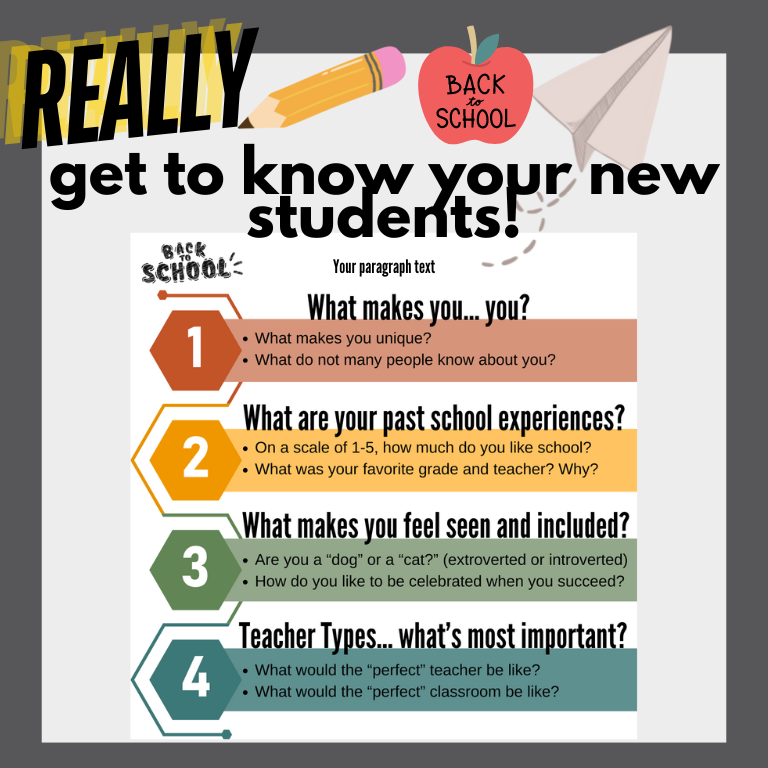
Use the REALLY Get to Know Your Students resource to gather insights into each of your students. Then, after 2-3 weeks of school, write down your students’ names and one special thing about them without referencing a class list or desk arrangement. Who did you remember last or not at all? Those are the students you can lean into and learn more about! (This resource is included in our Back to School Bundle.)
Favorite Resource(s)
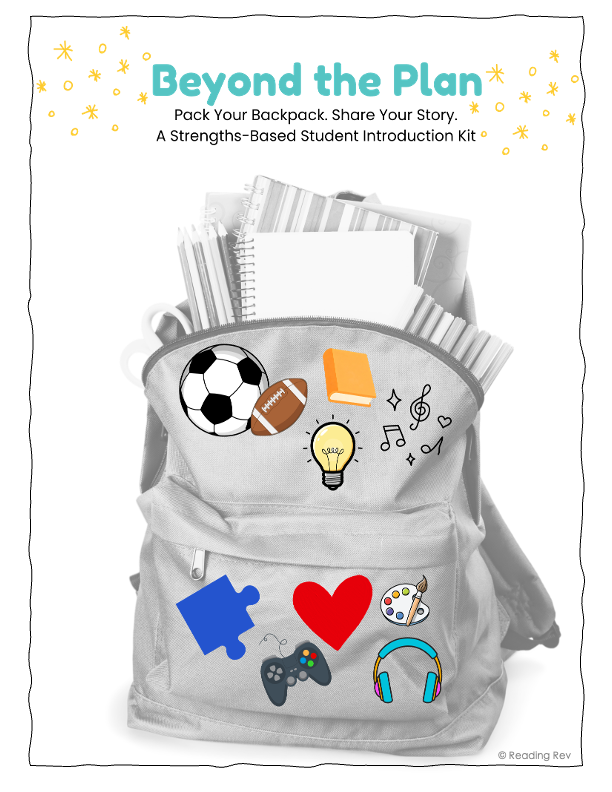
Reading Rev’s Beyond the Plan- An IEP or 504 is essential, but it can naturally focus our attention on what a student struggles with, what accommodations they need, and where they require support. Beyond the Plan intentionally invites students to share their strengths, interests, learning preferences, what happens when they're having a tough day, what they wish their teacher knew, what makes them feel safe, and what their dream classroom looks like. The resource also includes family input. It can make all the difference in creating positive relationships from day 1.
Research Corner
Roorda, Debora & Koomen, Helma & Spilt, Jantine & Oort, Frans. (2011). The Influence of Affective Teacher–Student Relationships on Students’ School Engagement and Achievement: A Meta-Analytic Approach. Review of Educational Research. 81. 493-529. 10.3102/0034654311421793.
Learner-Centered Teacher-Student Relationships Are Effective: A Meta-Analysis
Cornelius-White, Jeffrey. (2007). Learner-Centered Teacher-Student Relationships Are Effective: A Meta-Analysis. Review of Educational Research. 77. 113-143. 10.3102/003465430298563.
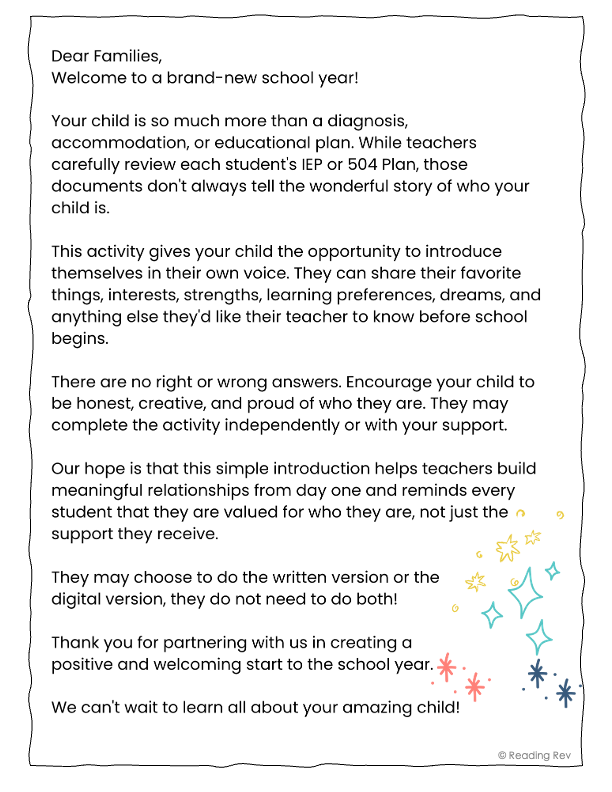
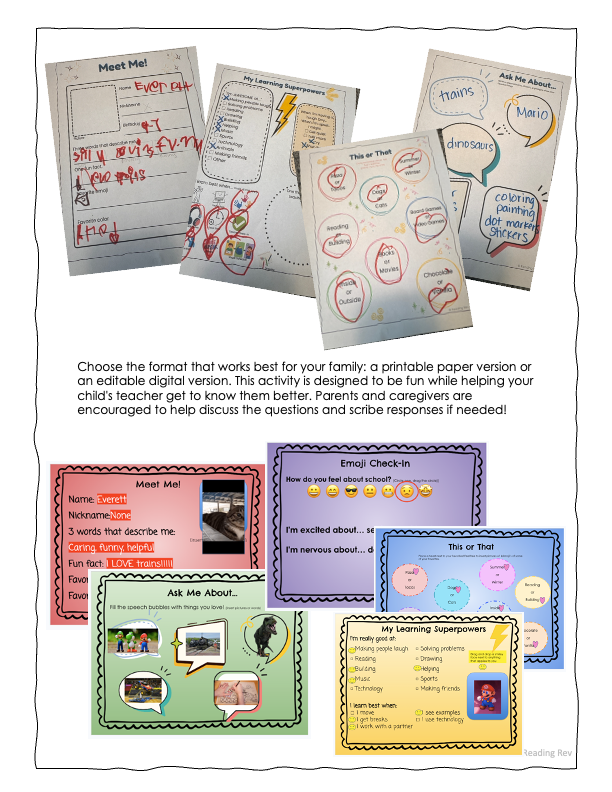
Both of these resources are inside the playbook!
Play 4: Explicit Instruction
Big Idea
Don't leave learning to chance.
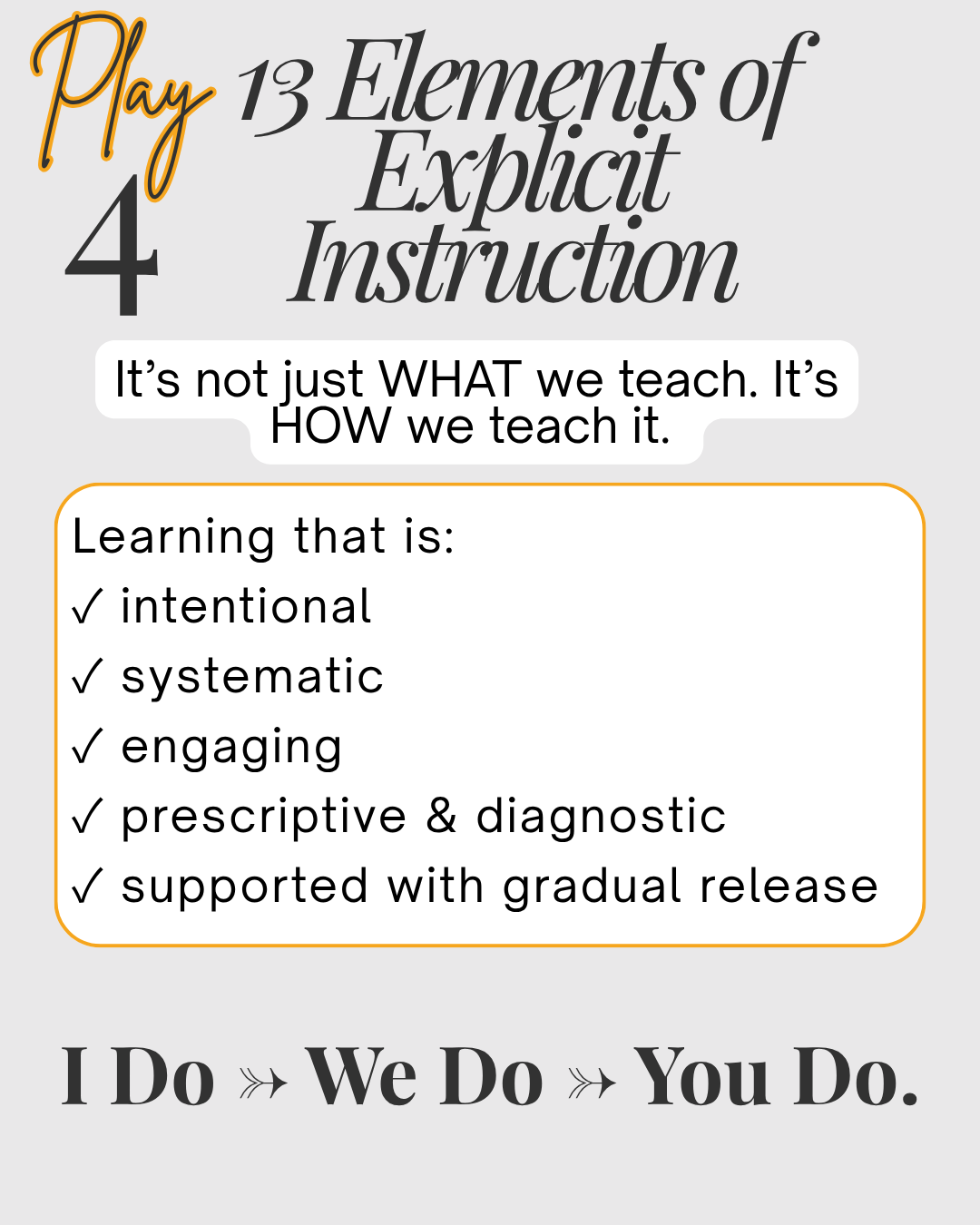
Explicit instruction is intentional, systematic, engaging, and success-oriented. Instead of asking students to discover what we want them to learn, we show them, practice with them, check their understanding, provide feedback, and gradually move them toward independence (Archer & Hughes, 2011).
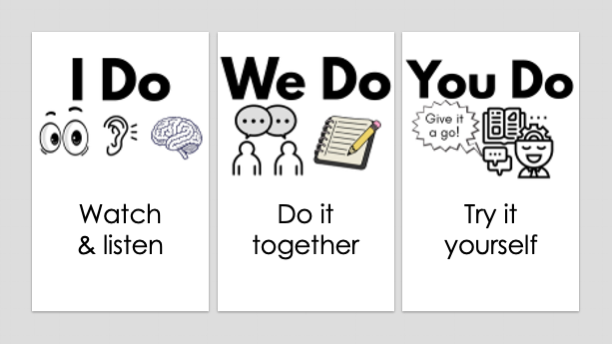
In other words: I Do → We Do → You Do.
Why It Matters
It's not just WHAT we teach that matters. It's HOW we teach it.
Explicit instruction reduces the guesswork for learners. Complex skills are broken into manageable steps, teachers clearly model what successful performance looks like, students receive plenty of supported practice, and teachers continually check for understanding before expecting independence.
And explicit instruction is much more than teachers lecturing! Students are actively involved throughout the lesson…speaking, writing, doing, practicing, and responding. As Dr. Anita Archer reminds us:
"Learning is not a spectator sport!"
Try This Tomorrow
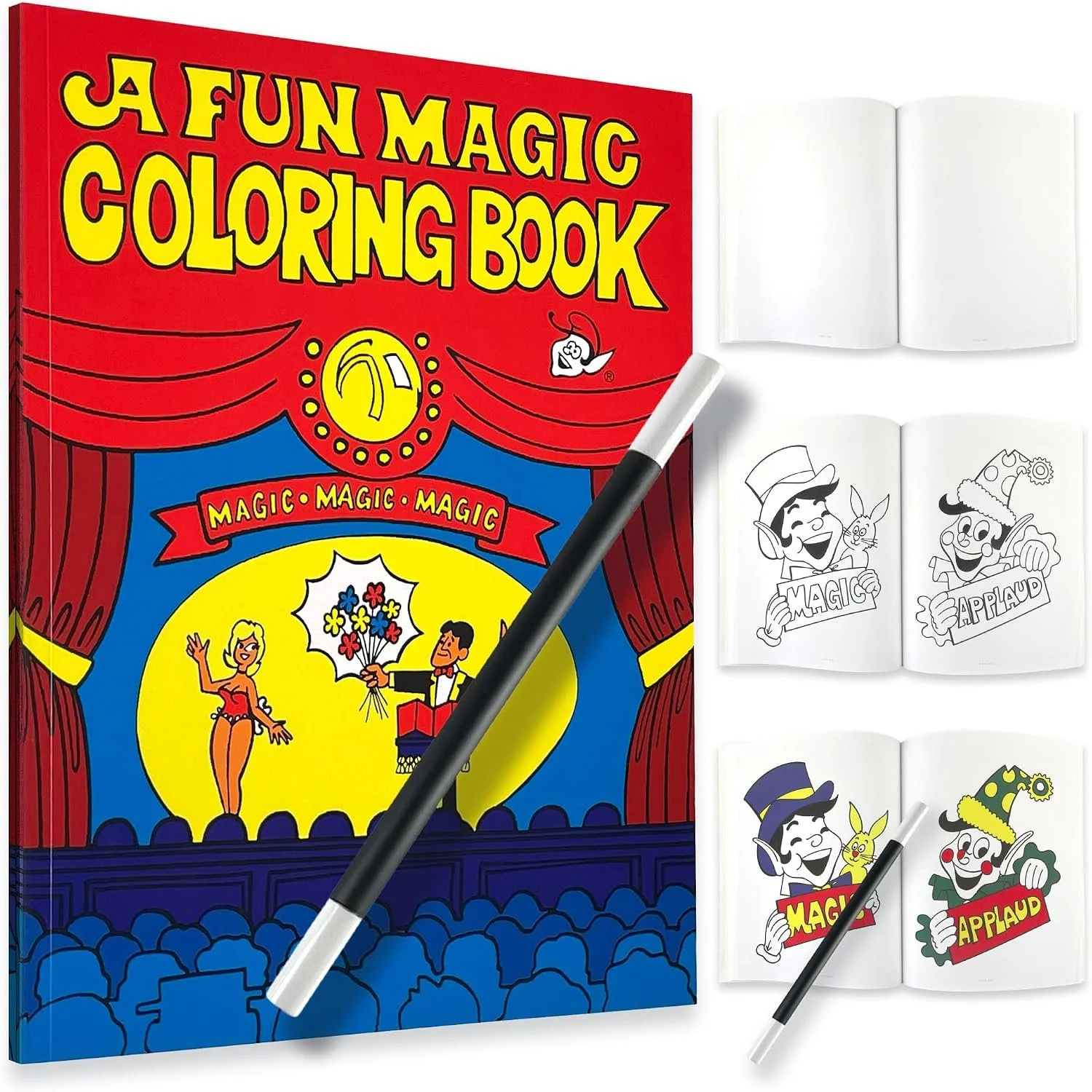
Introduce I DO, WE DO, YOU DO by explicitly teaching your students what they should be doing at each phase of a lesson. We often assume students know how to be students, but the beginning of the year is a great time to set expectations. I love to do this lesson with a Magic Coloring book lesson. Then, we build a class poster together! This is not already hung on the wall. When the lesson is memorable, and students are part of building the anchor chart, it actually anchors learning! You can watch the full lesson here.
I DO: Model exactly what you want students to do while I am teaching. They should be looking at me, attentively listening, and thinking!
WE DO: Practice together. Ask questions, require frequent responses, monitor understanding, and give immediate feedback. Gradually reduce your support as students become more successful. During this time, students should be following directions (thinking, participating, and doing).
YOU DO: When students are ready, release them to practice independently while you continue to monitor and provide feedback. It’s important that students know it doesn’t have to be perfect; they can just “Give it a go!”
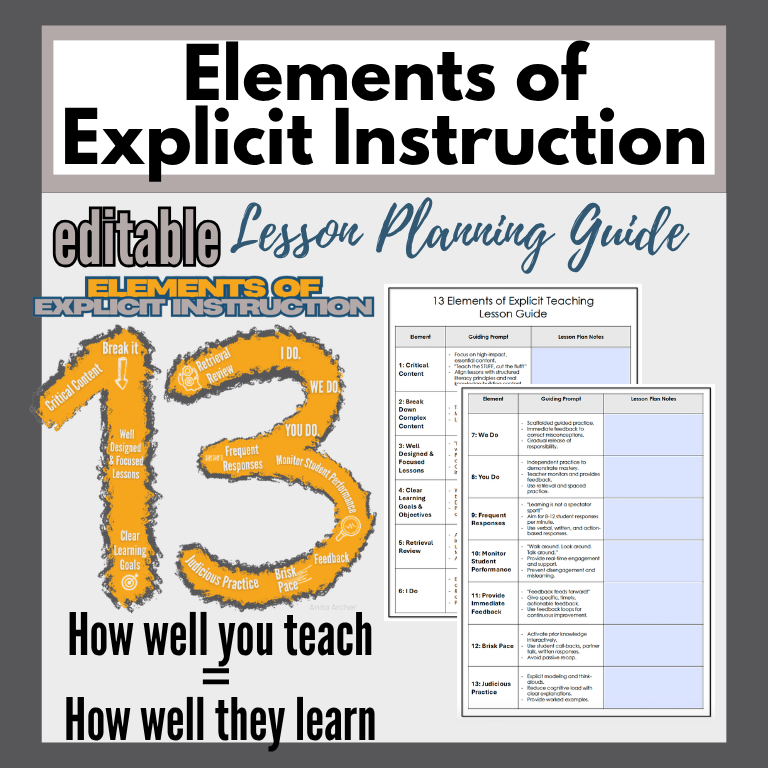
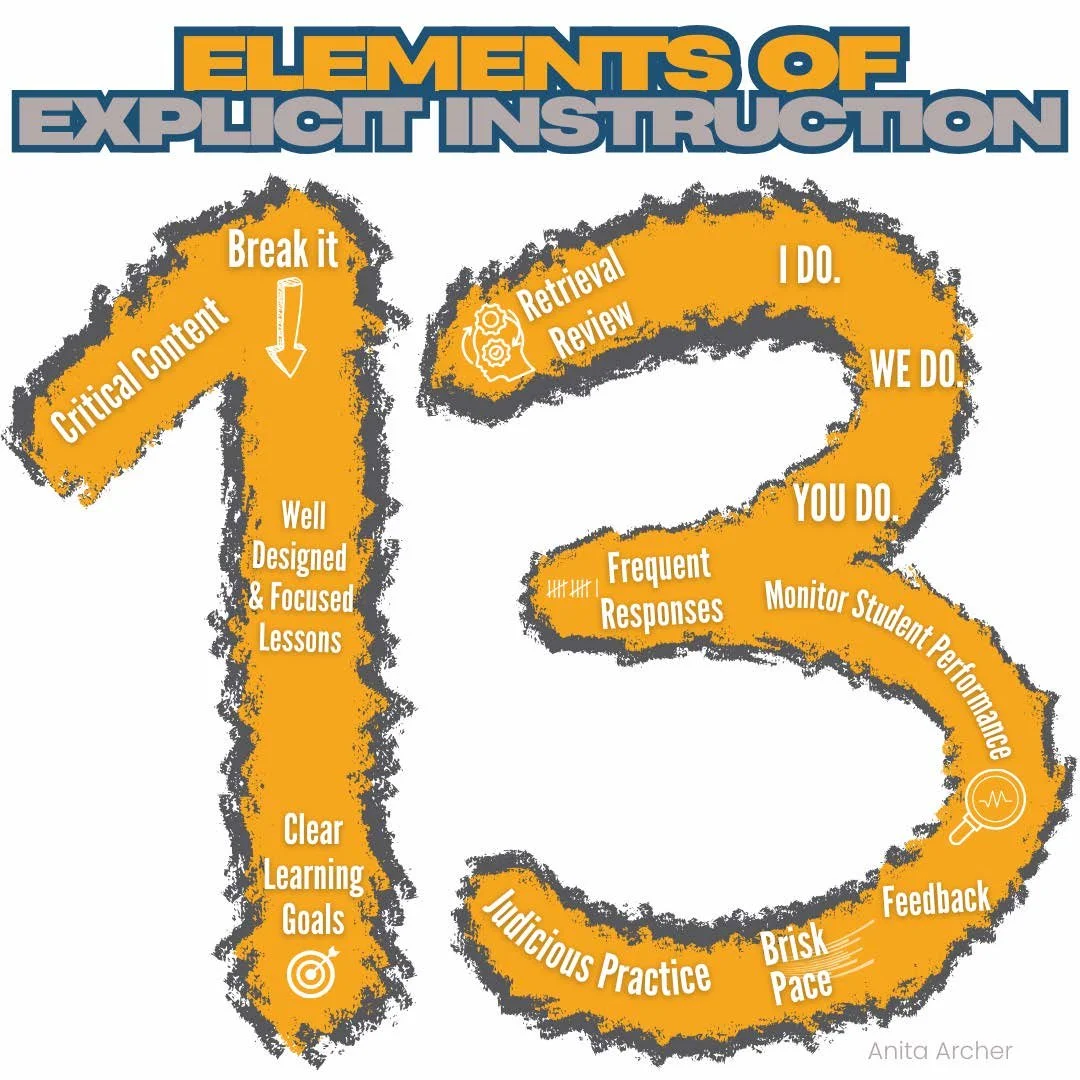
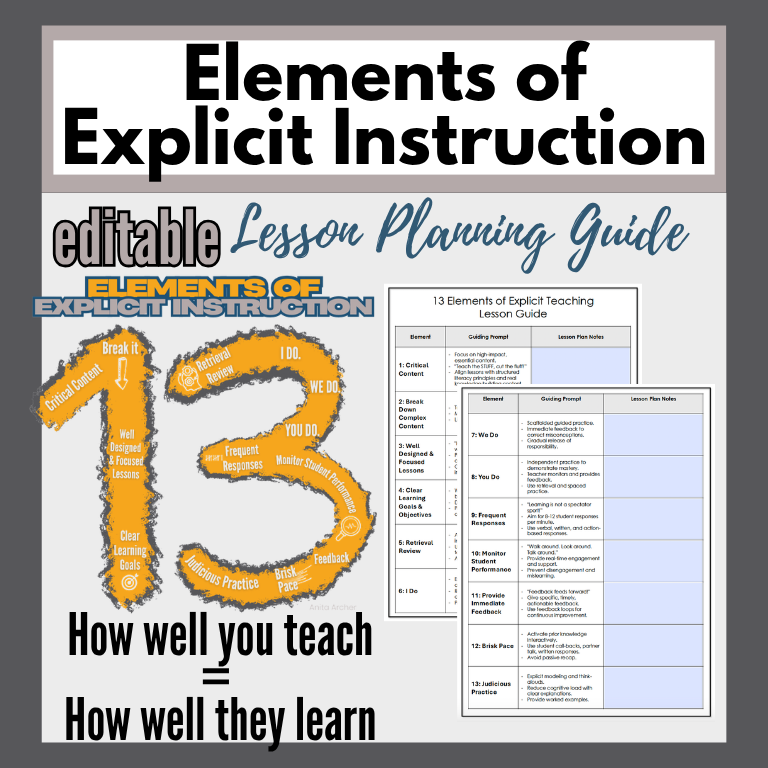
Want to take your explicit instruction even further? Anita Archer broke explicit instruction down into 13 practical elements you can use to strengthen your teaching and we created a resource guide to help you include these elements in your lessons throughout the year.
Favorite Resources
Explicit instruction: Effective and efficient teaching.by Anita Archer and Charles Hughes
Why Explicit Instruction Works: The Science of Learning blog
Explicit Instruction Guide & Editable Lesson Plan by Reading Rev (inside playbook)
Why Explicit Instruction Video
Research Corner
Archer, A. L., & Hughes, C. A. (2011). Explicit instruction: Effective and efficient teaching. Guilford Press.
Play 5: Teach Word Recognition Systematically
Big Idea
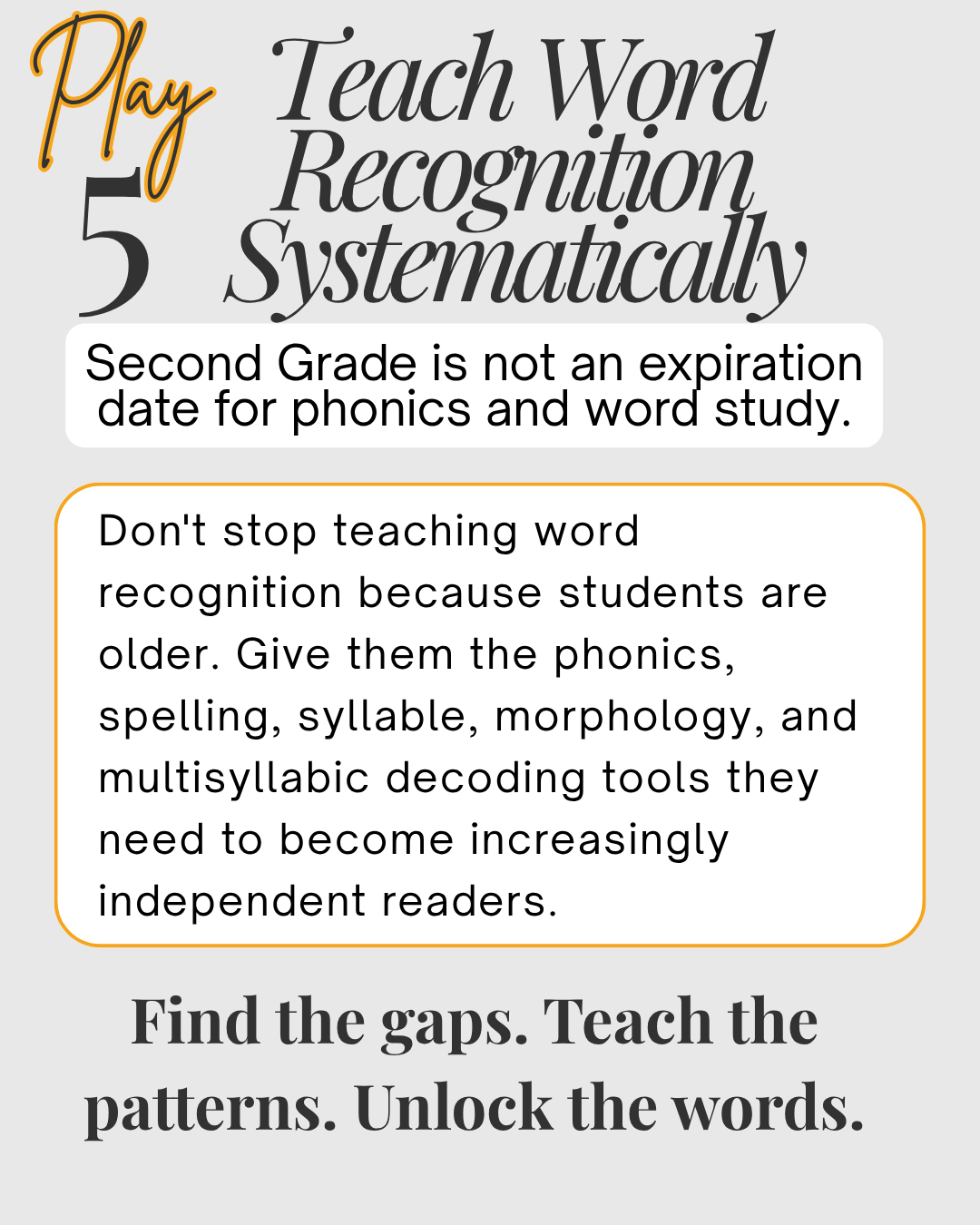
Second Grade is not an expiration date for phonics and word study.
By the intermediate grades, we want students to be fluent readers who can tackle increasingly complex text. But many students enter grades 3–5 with lingering gaps in foundational word-reading skills.
When those gaps exist, we can't comprehension-strategy our way around them.
Students still need explicit, systematic instruction in the skills they haven't mastered: phonics, spelling patterns, syllable types, morphology, and strategies for decoding increasingly complex multisyllabic words.
Why It Matters
As students move through the grades, the words they encounter get longer and more complex.
Consider the progression: act → action → active → inactive → reactivate
A student who understands sound-symbol relationships and syllables and morphemes has multiple tools for figuring out unfamiliar words. That's why word recognition instruction in the intermediate grades needs to grow up with our students. We're not simply repeating primary phonics instruction. We're helping students understand the increasingly sophisticated sound, spelling, syllable, and meaning structures of words so they can read and spell them accurately and efficiently.
And for students who still have foundational gaps? It’s not too late to give them the instruction that will help them be capable and confident readers and spellers. We just need to do it in an engaging way that doesn’t feel babyish.
Try This Tomorrow
Put one challenging multisyllabic word on the board. Let’s try thermoregulation.
Instead of telling students the word, teach them how to tackle it using word parts, syllables, and phonics patterns.
1. Look for meaningful word parts (roots, bases, affixes)
therm + regul + ation
therm = heat (like thermostat)
regulate = rule, control, direct
ion = process or action, suffix that makes verb into nouns
This gives students an early clue: Could this word have something to do with the process of controlling heat?
2. Break it into syllables (Look for the vowels and vowel teams. These give us clues about where the syllables may be.)
ther • mo • reg • u • la • tion has 6 syllables.
3. Pronounce each part
ther → /thər/
mo → /mō/
reg → /rĕg/
u → /ū/
la → /lā/
tion → /shən/
Then blend: ther-mo-reg-u-la-tion → thermoregulation
4. Use the morphology to determine meaning
thermo- = heat
regulation = control or managementSo thermoregulation means the process of controlling or maintaining temperature.Then make it interesting: “When you're hot and start sweating, your body is using thermoregulation to cool itself down.”
Even better: Build a word family
thermal → relating to heat
thermometer → instrument for measuring temperature
thermostat → device for controlling temperature
thermoregulation → process of controlling temperature
Five minutes of intentional word study can give students a strategy they'll use again and again. The goal isn't to teach students one word. It's to teach them how words work.
Favorite Resources
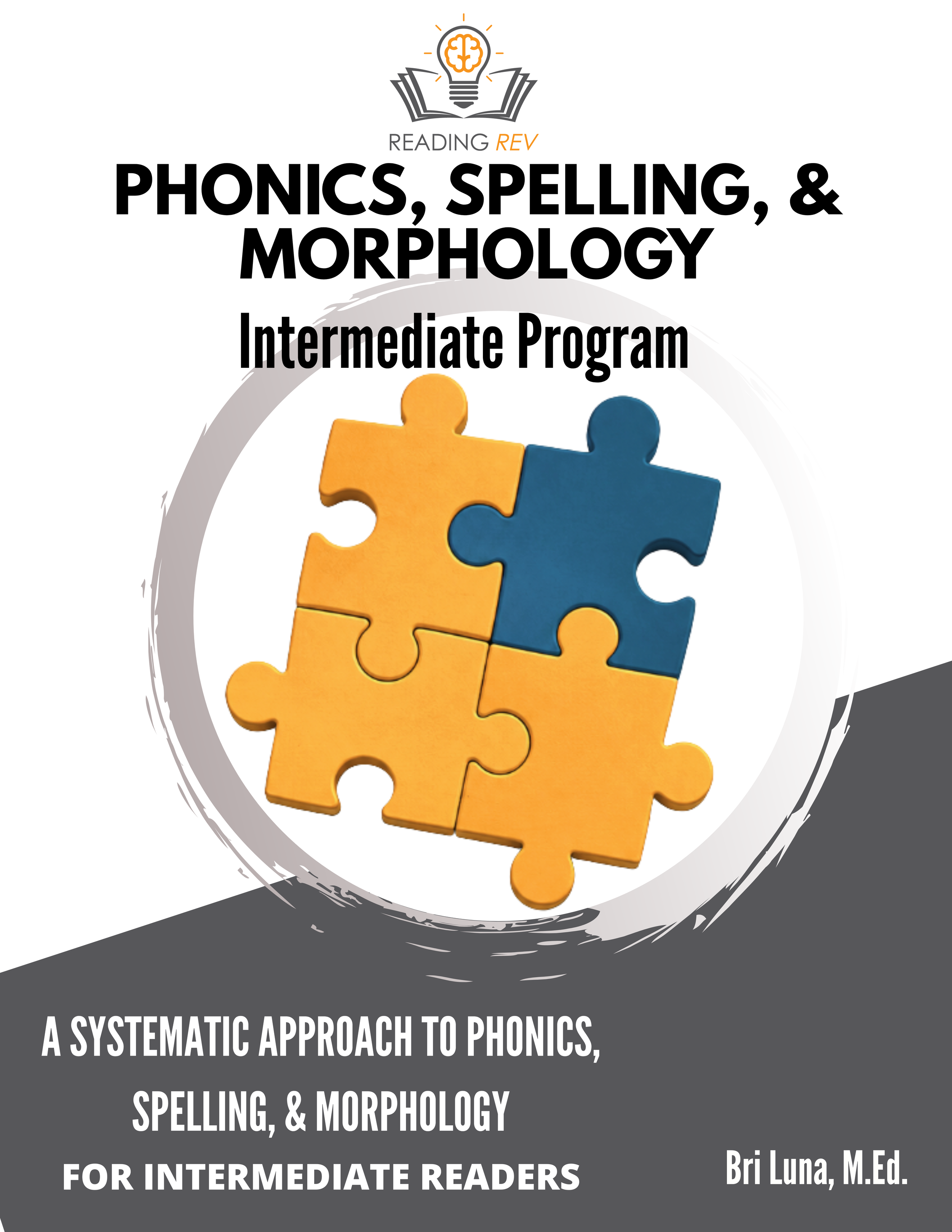
Reading Rev Phonics, Spelling & Morphology Program
Need an easy way to systematically teach word study to students in grades 3–5? Don’t have time to spend hours planning it yourself? This is for you!
The Reading Rev Phonics, Spelling & Morphology Program integrates phonics, spelling, syllable types, morphology, and etymology. It focuses on multisyllabic word study using explicit, systematic instruction designed specifically for intermediate learners. This program was made for Tier 1 third grade or intervention beyond in grade 4 and beyond.
Get a free sample here.
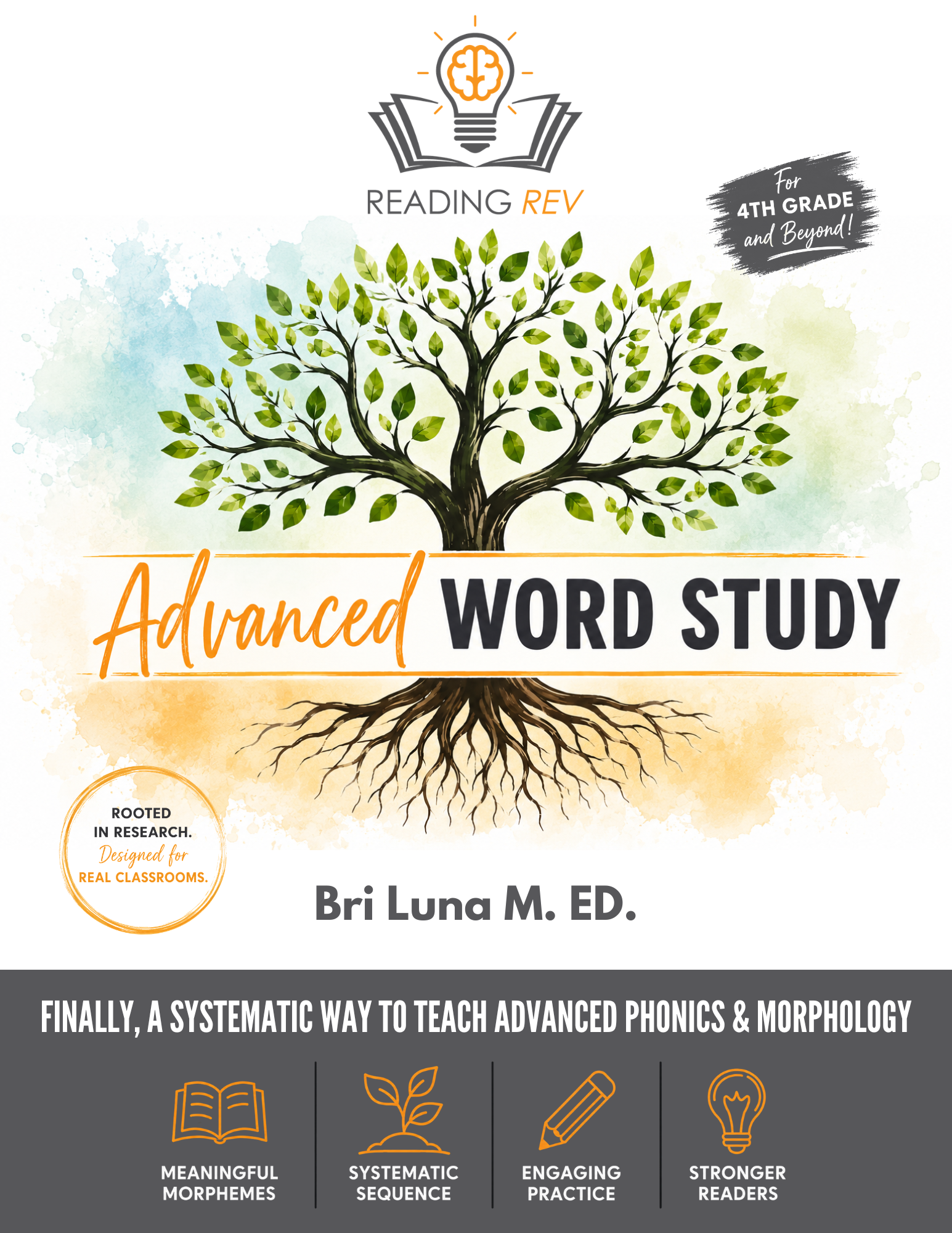
Reading Rev Advanced Word Study
Ready to take word study even further? This program mimics the example above. Advanced Word Study helps older students tackle increasingly sophisticated words through morphology, multisyllabic decoding, spelling, and meaningful word analysis.
Newly updated to include digital workbook that can be assigned in Google Classroom! Get a free sample here.
Research Corner
This is one of those areas where the research is clear: systematic word-reading instruction isn't just for emergent readers.
The National Reading Panel's meta-analysis found that systematic phonics instruction was significantly more effective than instruction containing little or no phonics. Importantly for intermediate teachers, the benefits weren't limited to kindergarten and first grade. Systematic phonics produced significant benefits through sixth grade and for students experiencing difficulty learning to read (National Reading Panel, 2000).
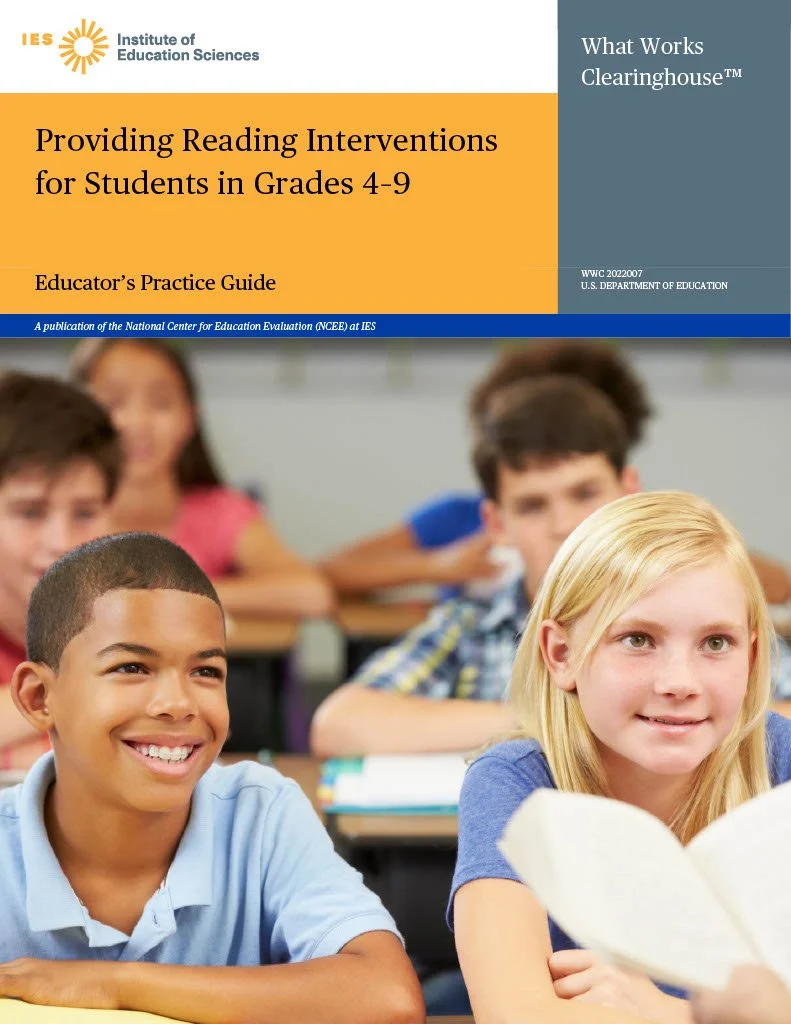
Research on older struggling readers also supports explicit instruction for tackling complex words. The What Works Clearinghouse's practice guide for grades 4–9 gives its highest evidence rating, Strong Evidence, to the recommendation that educators build students' decoding skills so they can read complex multisyllabic words. (Vaughn et al., 2022)
And as words become more sophisticated, morphology matters too. Explicitly analyzing both syllables and morphemes can strengthen older struggling readers' ability to tackle multisyllabic words (Bhattacharya, 2020).
Bhattacharya, A. (2020). Syllabic versus morphemic analyses: Teaching multisyllabic word reading to older struggling readers. Journal of Adolescent & Adult Literacy, 63(5), 491–497.
National Reading Panel. (2000). Teaching children to read: An evidence-based assessment of the scientific research literature on reading and its implications for reading instruction: Reports of the subgroups (NIH Publication No. 00-4754). National Institute of Child Health and Human Development.
Vaughn, S., Gersten, R., Dimino, J., Taylor, M. J., Newman-Gonchar, R., Krowka, S., Kieffer, M. J., McKeown, M., Reed, D., Sanchez, M., St. Martin, K., Wexler, J., Morgan, S., Yañez, A., & Jayanthi, M. (2022). Providing reading interventions for students in grades 4–9 (WWC 2022007). National Center for Education Evaluation and Regional Assistance, Institute of Education Sciences, U.S. Department of Education.
Play 6: Build Vocabulary Intentionally
Big Idea
Vocabulary knowledge is a critical part of language comprehension, but we can't possibly directly teach students every word they will encounter.
That's why strong Tier 1 vocabulary instruction does two things:
1. Explicitly teaches carefully selected words.
2. Teaches students how to figure out unfamiliar words independently.
Our goal isn't simply to help students learn today's vocabulary lists, it's to build word learners.
Why It Matters
Think about what happens when a student encounters too many unfamiliar words in a text. Even if they can decode every word accurately, they may have very little idea what the text actually means.
Vocabulary knowledge supports comprehension across everything students read, from a science article about thermoregulation to a social studies text describing a revolutionary movement.
But vocabulary instruction needs to go beyond: Word → Definition → Memorize → Quiz
Knowing a word deeply means understanding how it sounds, how it's spelled, what it means, how it's used, how it's built, and how it connects to other words and idea (Beck et al., 2013). And because students will encounter thousands of words we never explicitly teach, they also need strategies for figuring out unfamiliar words on their own.
Try This Tomorrow
Try these two vocabulary routines with a word from something you're already teaching.
Routine #1: Explicitly Teach the Word
Use the POSSUM Vocabulary Routine to help students build a rich representation of the word. (Mechelke, 2023)
P – Phonology: How does the word sound? Say it aloud and examine its sounds and syllables.
O – Orthography: How is the word spelled? Connect the sounds to the written letters and patterns.
S – Syntax: How does the word function in a sentence? Identify its grammatical role and how it can be used.
S – Semantics: What does the word mean? Develop a clear, student-friendly understanding of its meaning.
U – Understanding: What connections can we make to the word? Link it to background knowledge, experiences, examples, and related concepts.
M – Morphology: How is the word built? Examine meaningful parts such as bases, roots, prefixes, and suffixes.
Then keep that word alive throughout the week. Vocabulary isn't learned in one exposure.
Routine #2: Teach Students What to Do When They DON'T Know a Word
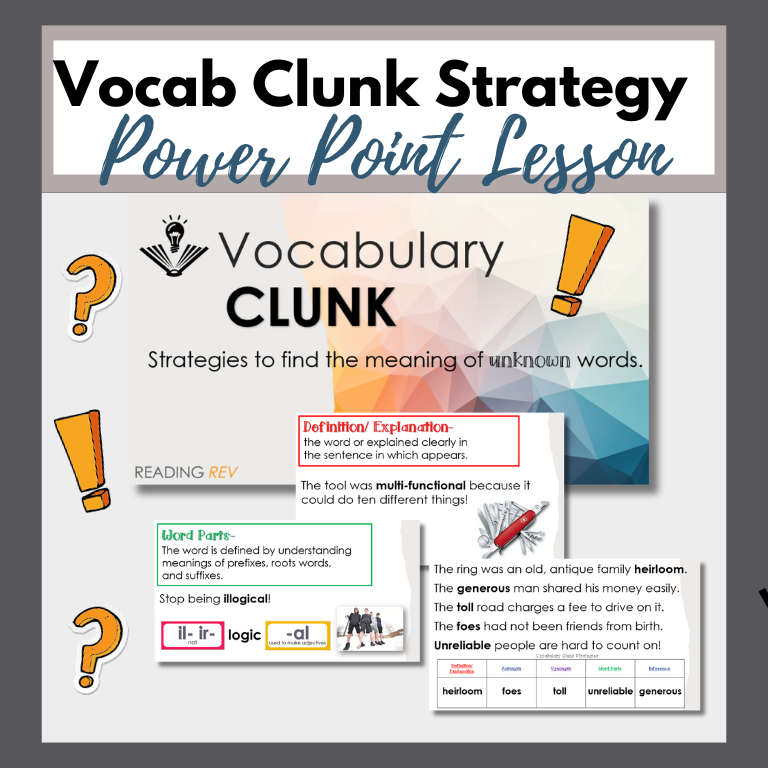
Teaching students explicit strategies for identifying and resolving “clunks” (words or concepts that interfere with understanding) can support students as they monitor and repair their own comprehension (Klingner et al., 1998). This is part of the Collaborative Strategic Reading (CSR) Rooted in Research Method mentioned above.
LOOK INSIDE the word.
Do I recognize a prefix, root, base, or suffix that gives me a clue?LOOK INSIDE the text.
What clues do the sentence and surrounding sentences give me? Are there definitions, examples, synonyms, antonyms, or explanations nearby?LOOK OUTSIDE the text.
What do I already know about this topic that might help me determine the meaning?Then put the clues together and ask, "What meaning would make sense here?"
This moves students away from immediately asking the teacher, reaching for a dictionary and toward becoming strategic, independent word learners.
Favorite Resources
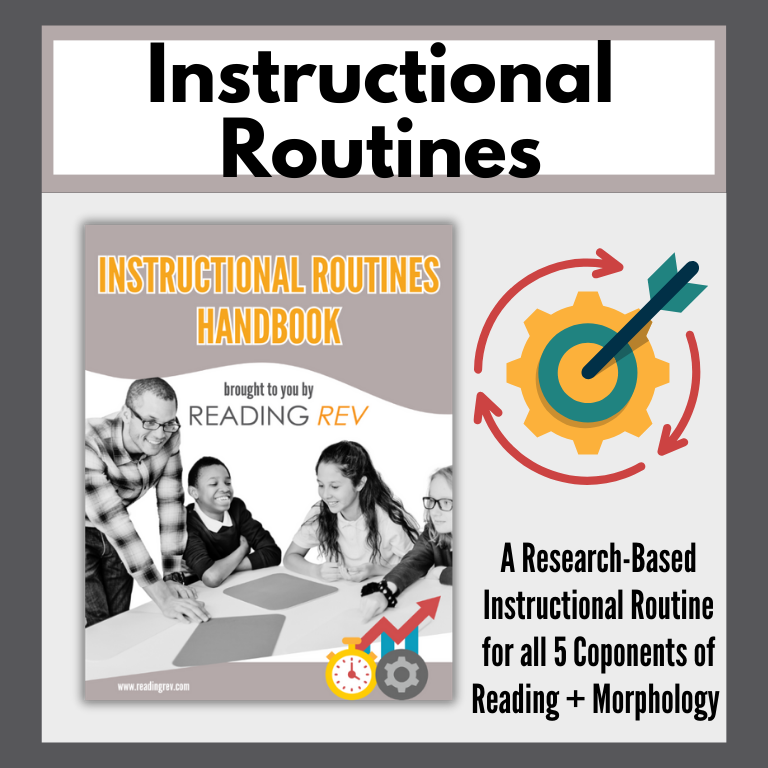
Instructional routines provide teachers and students with consistent, repeatable ways to approach instruction and learning. Reading Rev’s Favorite Vocabulary Instructional Routines:
Use the POSSUM approach when you are explicitly teaching a high-value, tier 2 word. We call these “suitcase words” because these are the words we want students to carry with them and use in their oral conversations and writing.
Use Look Inside, Inside, Outside when you want to teach students how to independently tackle unfamiliar vocabulary they encounter while reading.
The more consistently we model these routines, the more students will start utilizing them independently. Find out more about instructional routines for all 5 components of reading here.
Research Corner
Research on vocabulary instruction consistently points to the importance of explicit instruction, multiple meaningful exposures, active engagement, morphology, and teaching students strategies for determining unfamiliar word meanings.
Bringing Words to Life - Guilford Press
Beck, I. L., McKeown, M. G., & Kucan, L. (2013). Bringing words to life: Robust vocabulary instruction (2nd ed.). Guilford Press.
Klingner, J. K., & Vaughn, S. (1998, March). Using collaborative strategic reading. AdLit. https://www.adlit.org/topics/comprehension/using-collaborative-strategic-reading
Mechelke, M. (2023, May 31). Explicit vocabulary instruction using the POSSUM approach. Iowa Reading Research Center, University of Iowa.
THE PLAY
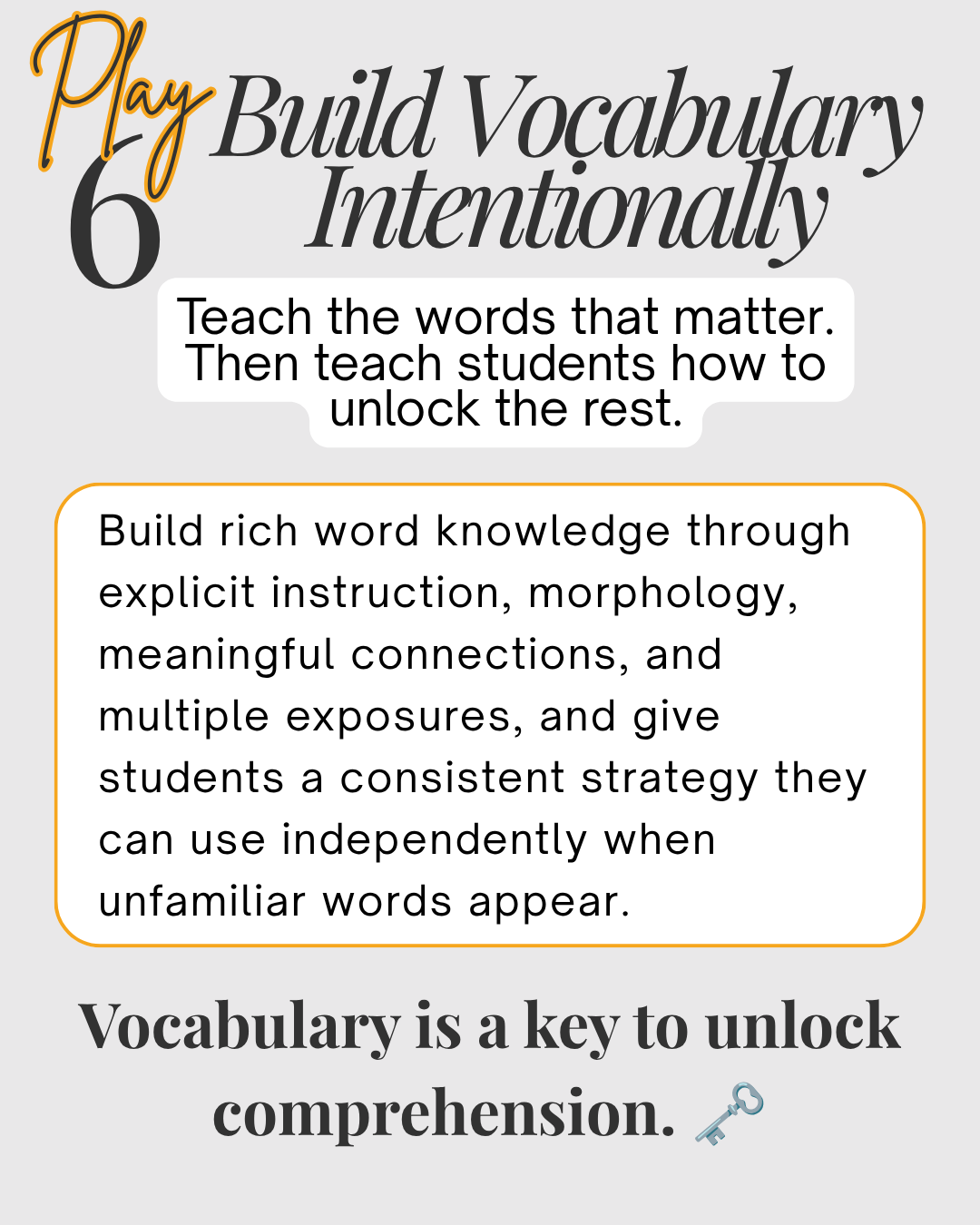
Teach the words that matter. Then teach students how to unlock the rest.
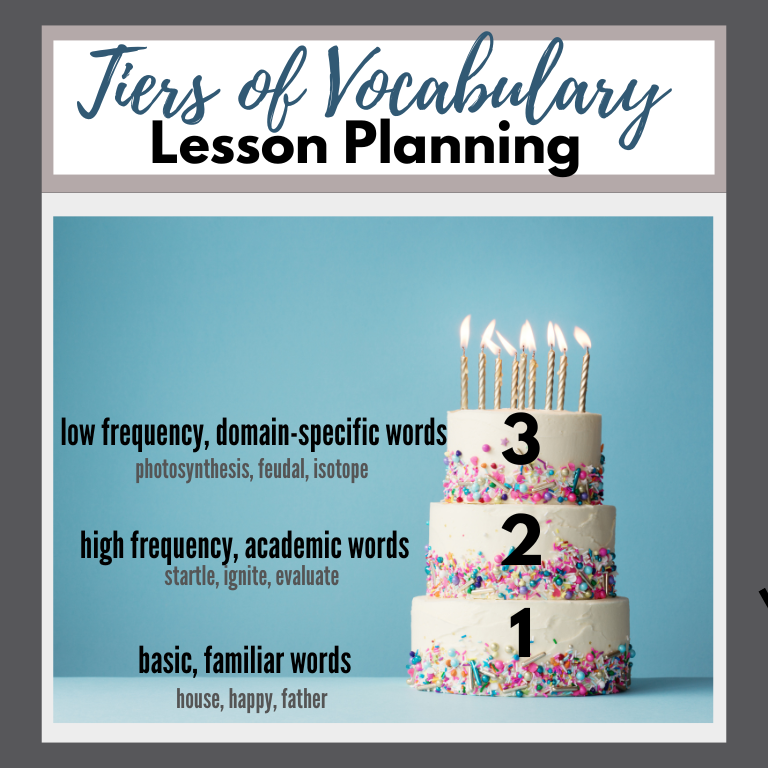
Build rich word knowledge through explicit instruction, morphology, meaningful connections, and multiple exposures, and give students a consistent strategy they can use independently when unfamiliar words appear. You can find our Vocabulary Lesson Planning, Vocabulary CLUNK Slides, and highly-effective Instructional Routines inside the Playbook.


Play 7: Teach Language Comprehension Every Day
Big Idea
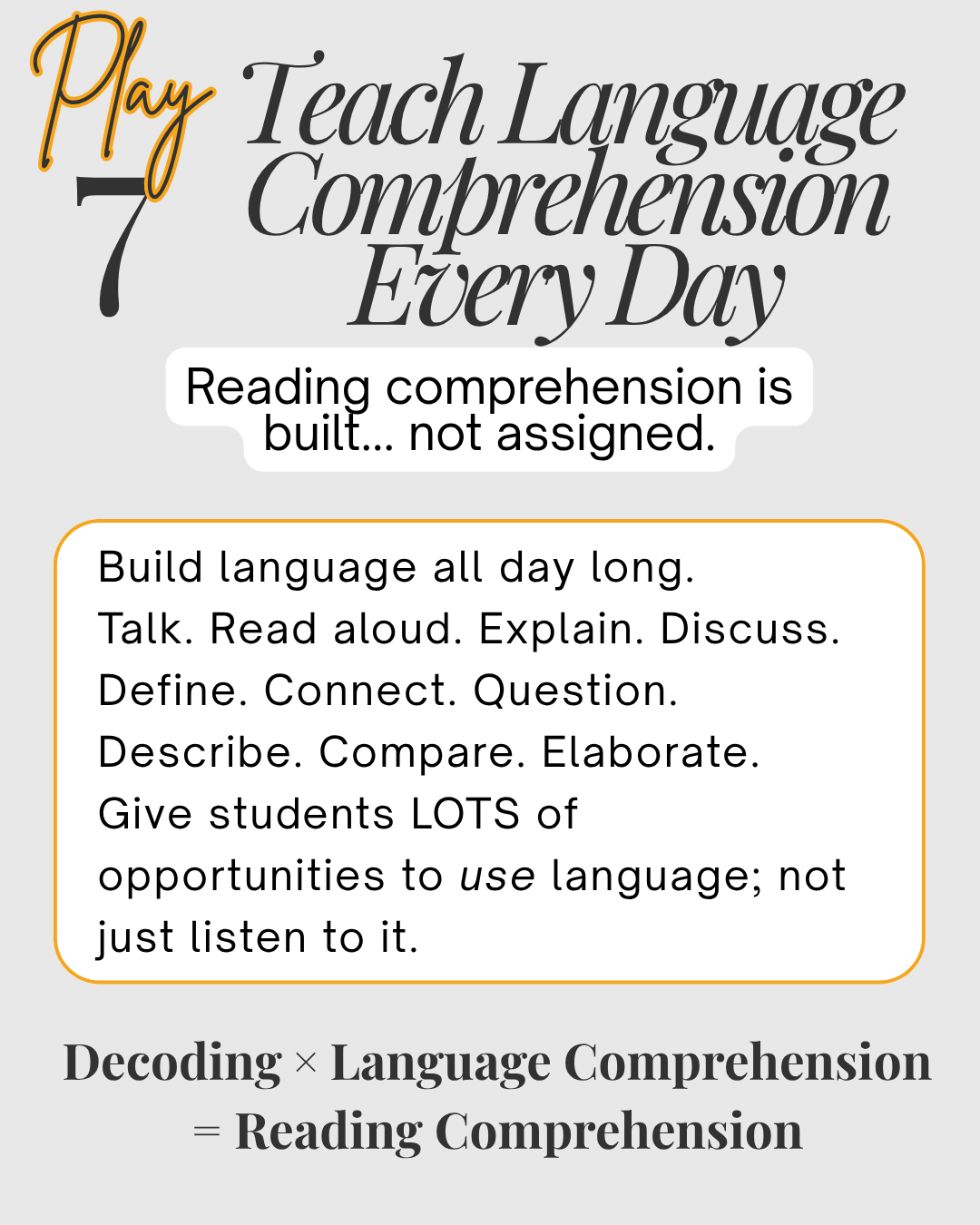
Reading comprehension is built, not assigned.
We can ask students comprehension questions. We can give them passages. We can have them find the main idea, make an inference, or answer questions at the end of a chapter.
But none of those things, by themselves, build comprehension.
To understand what they read, students need something to comprehend with: knowledge, vocabulary, understanding of language and sentence structure, and the ability to create a meaningful mental representation of the text.
Why It Matters
The Simple View of Reading gives us a beautifully simple way to think about reading comprehension:
Decoding × Language Comprehension = Reading Comprehension (Gough & Tunmer, 1986)
Students need to be able to read the words AND understand the language those words represent.
Because the two components are multiplied, weakness on either side affects the outcome. Think about a student who reads this sentence accurately and fluently:
The nocturnal predator descended upon its unsuspecting prey.
But, what if the student doesn't know nocturnal, predator, descended, unsuspecting, or prey?
Accurate reading does not automatically equal comprehension.
This is why we need to intentionally develop the language comprehension side of reading, not only during intervention, but every single day in Tier 1 instruction.
Build the Language Side
Language comprehension is enormous, but there are four areas we can intentionally strengthen throughout the school day:
1. Build Background Knowledge
Knowledge gives students something to connect new learning to.
Rather than jumping from one disconnected passage to another simply to practice a comprehension skill, spend time reading, talking, writing, and learning about connected topics.
Knowledge is sticky. The more students know, the more they have to connect new learning to.
2. Build Vocabulary
Don't assume students know the words simply because they can decode them. Explicitly teach important vocabulary, explore morphology and word relationships, and create opportunities for students to hear, say, read, and write new words.
3. Teach Syntax & Sentence Structure
Sometimes students know every individual word in a sentence… and still don't understand the sentence. Teach students to notice how words, phrases, clauses, conjunctions, pronouns, and punctuation work together to communicate meaning.
4. Teach Students to Visualize & Verbalize
Strong comprehenders create a mental representation of what they hear and read. Ask students to describe what they are picturing. Encourage them to verbalize details, relationships, actions, and changes as a text unfolds. The goal isn't simply to make a "movie in your mind." It's to turn language into meaning.
Try This Tomorrow
Before tomorrow's read-aloud, science lesson, social studies text, or novel, stop before you ask:
"What comprehension skill am I teaching?" Instead ask: "What will my students need to KNOW and UNDERSTAND to comprehend this text?"
Choose just one thing to intentionally build before or during reading:
Teach one piece of background knowledge.
Explicitly teach 2–3 essential words.
Unpack one complex sentence together.
Pause and ask students to describe what they're visualizing.
It doesn't need to become another 30-minute lesson. A few intentional minutes of language-building woven throughout the day add up.
Favorite Resources
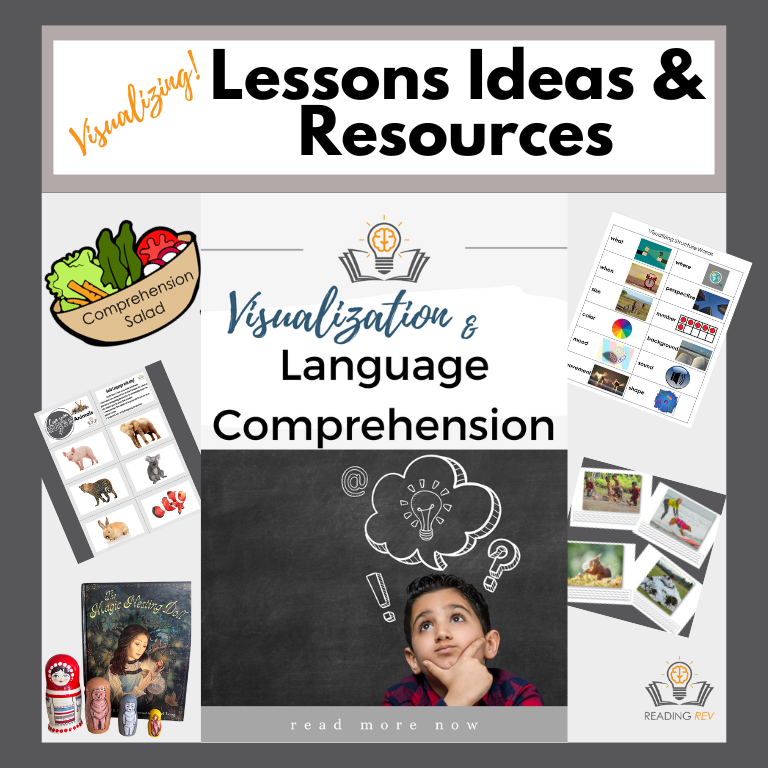
We've spent a lot of time at Reading Rev digging into the language comprehension side of reading. Start with our four-part series:
Research Corner
Gough, P. B., & Tunmer, W. E. (1986). Decoding, reading, and reading disability. Remedial and Special Education, 7(1), 6–10. https://doi.org/10.1177/074193258600700104
International Dyslexia Association. (2025). Perspectives on Language and Literacy, 51(1).
Winter 2025 issue of Perspectives on Language and Literacy
Scarborough, H. S. (2001). Connecting early language and literacy to later reading (dis)abilities: Evidence, theory, and practice. In S. B. Neuman & D. K. Dickinson (Eds.), Handbook of early literacy research (Vol. 1, pp. 97–110). Guilford Press.
THE PLAY
Build knowledge. Build vocabulary. Build oral language. Unpack complex sentences. Help students create meaning from language.
The more students know and understand, the more they can understand what they read.
Find our Language Comprehension Resource Pack, along with many other language-building ideas and games inside the Reading Rev VIP Vault!
Play 8: Connect Reading & Writing
Big Idea
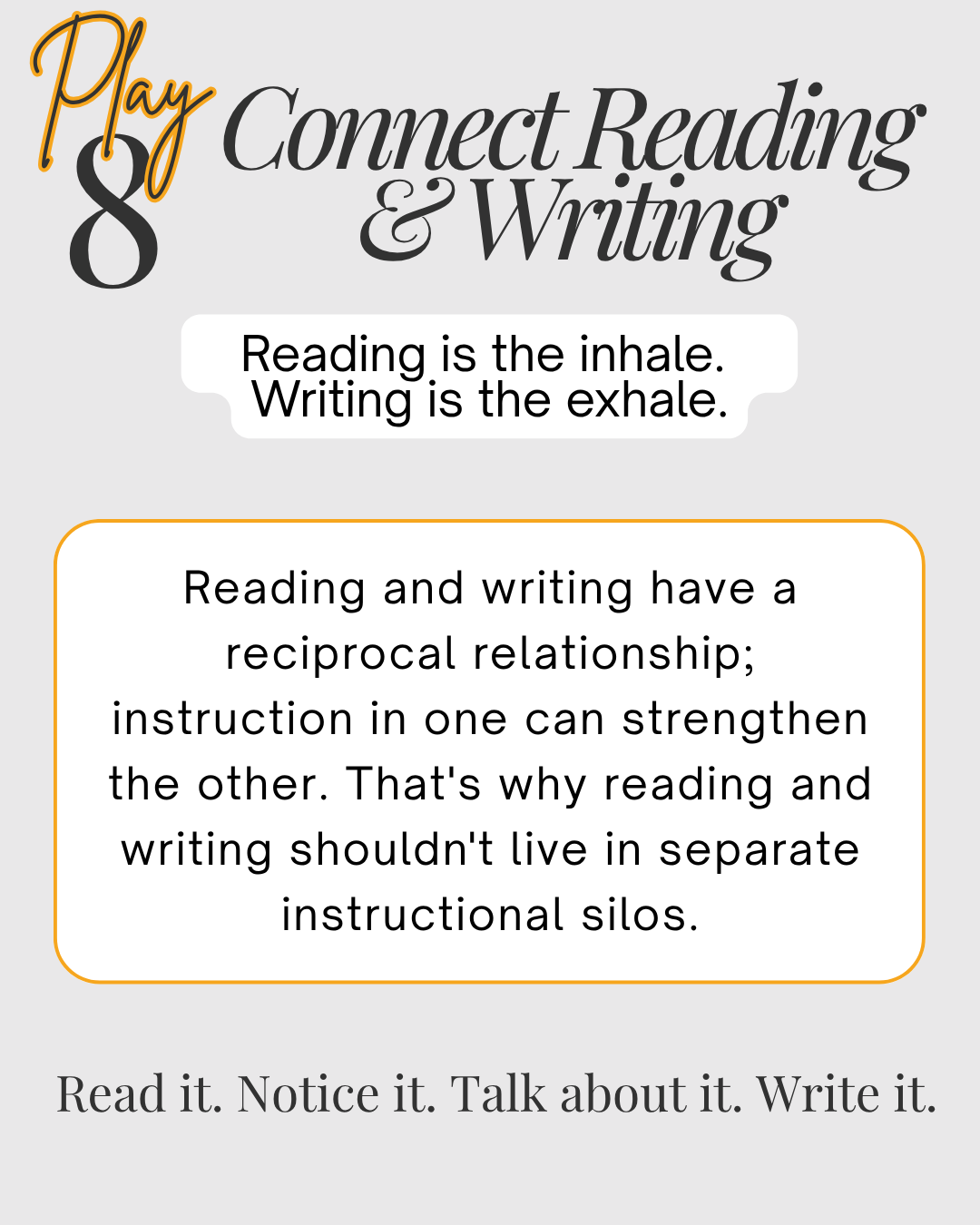
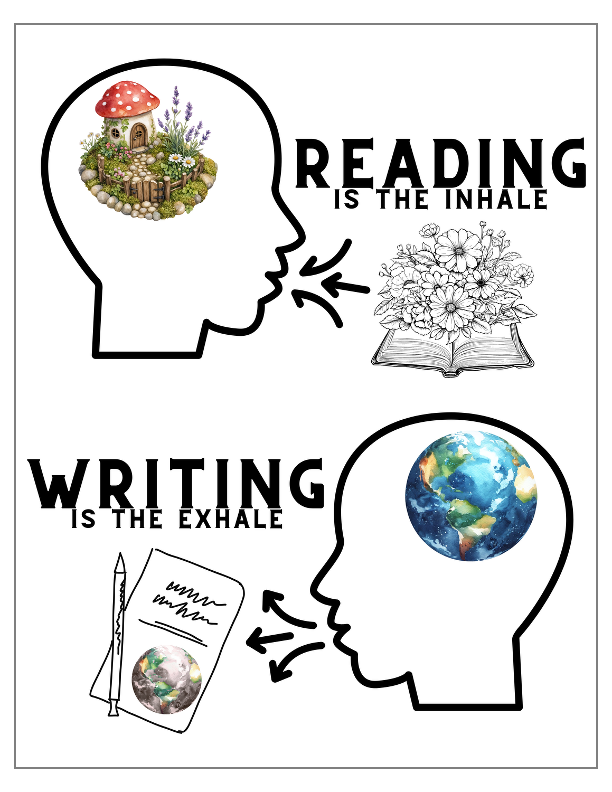
Reading is the inhale. Writing is the exhale.
We often separate our literacy block into neat little boxes: phonics time, reading time, writing time, vocabulary time...but our brains don't organize literacy that way.
Reading and writing draw upon many of the same skills, knowledge, and language. When students read, they encounter vocabulary, sentence structures, text organization, ideas, evidence, and author's craft.
When they write, they have to put those things to work.
The goal isn't to add more to your literacy block. It's to intentionally connect the reading and writing you're already doing.
Why It Matters
Reading and writing have a reciprocal relationship. Longitudinal research with students in grades 3–6 found significant relationships between reading and writing development (Kim et al., 2018).
Even more compelling for instruction, a major meta-analysis found that having students write about what they read improves reading comprehension. Teaching writing and increasing opportunities for students to write also produced positive effects on reading outcomes (Graham & Hebert, 2011).
So instead of asking, "How am I going to fit in reading AND writing?"
Try asking, "How can I use what we're already reading to strengthen students' writing?"
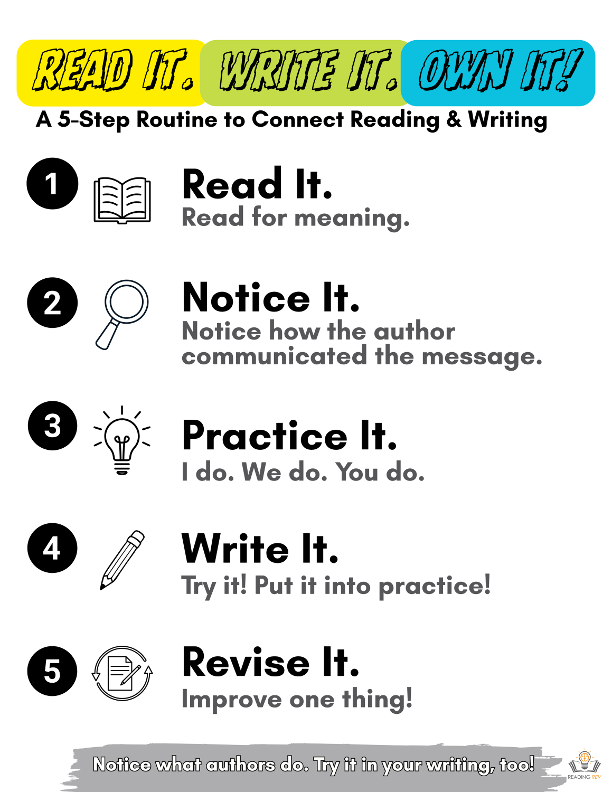
Try This Tomorrow: Read It. Write It. Own It.
You don't need another program, another block of instructional time, or a special mentor text. Start with something students are already reading, fiction or nonfiction, in ELA, science, social studies, or any other content area, and use this simple five-step routine:
1. READ IT: Read for meaning.
Focus first on understanding the text. What is the author telling us? What did we learn?
2. NOTICE IT: Notice ONE thing the author did.
Return to a sentence, paragraph, or section. Notice something that aligns with what you're already teaching in writing. It might be: an interesting sentence, structure, precise vocabulary, a transition, text organization, supporting evidence, punctuation, an effective introduction or conclusion. Ask, "What did the author do here, and why does it work?"
3. PRACTICE IT: Explicitly teach the skill. Don't expect students to learn something simply because they saw an example.
I DO: Model it. WE DO: Practice it together. YOU DO: Give it a try. Keep it short and focused.
4. WRITE IT: Put it into practice. Have students apply the skill while writing about something they are already reading or learning. It might be one strong sentence, a short response, a paragraph, or part of a larger composition. Not every writing opportunity needs to become an essay!
5. REVISE IT: Improve ONE thing. Give students a specific revision lens connected to what you just taught. Instead of "Make your writing better," try,
"Can you combine these sentences?"
"Did you use evidence to support your idea?"
"Can you replace that word with something more precise?"
One skill. One intentional revision.
READ IT → NOTICE IT → PRACTICE IT → WRITE IT → REVISE IT
That's the reading-writing connection in action. See it in reading. Try it in writing.
Favorite Resource:
We've created a simple Read It. Write It. Own It! Lesson Guide and anchor chart to help you make this routine part of your instruction. The goal isn't another writing program. It's a simple, repeatable routine that can be embedded into any evidence-based literacy curriculum using the texts and content you're already teaching.
Want to Go Deeper?
Want more systematic support for connecting comprehension and writing? Explore Knowledge Acquisition and Transformation (KAT), developed by Dr. Kay Wijekumar and colleagues. KAT was featured in our Rooted in Research play and explicitly teaches students to use text structure to identify and organize important information, generate main ideas, summarize, and make inferences. Want to dig deeper into how to teach writing itself? Explore our Writing Rope Blog Series, based on Joan Sedita's Writing Rope. We've broken down all five strands: transcription, syntax, text structure, critical thinking, and writing craft, all through the intermediate lens.
Research Corner
Reading and writing don't just happen to work well together. Research supports intentionally connecting them. Kim et al. (2018) followed students from grades 3–6 and found significant relationships between reading and writing development. Reading and writing share underlying language and cognitive processes, although the relationships between specific reading and writing skills vary. Graham and Hebert (2011) provide even stronger instructional evidence for making the connection. Their meta-analysis found that having students write about what they read improved reading comprehension. Teaching writing and providing students with additional opportunities to write also positively affected reading outcomes. The takeaway? We don't have to choose between reading and writing. We can intentionally connect the two.
Research & Resources
Graham, S., & Hebert, M. (2011). Writing to read: A meta-analysis of the impact of writing and writing instruction on reading. Harvard Educational Review, 81(4), 710–744. https://doi.org/10.17763/haer.81.4.t2k0m13756113566
Kim, Y.-S. G., Petscher, Y., Wanzek, J., & Al Otaiba, S. (2018). Relations between reading and writing: A longitudinal examination from grades 3 to 6. Reading and Writing, 31(7), 1591–1618. https://doi.org/10.1007/s11145-018-9855-4
Sedita, J. (2023). The Writing Rope: A framework for explicit writing instruction in all subjects. Paul H. Brookes Publishing Co. Wijekumar, K., Hudson, A., Lambright, K., Owens, J. K., Binks-Cantrell, E., Beerwinkle, A., & Stack, A. (2023). Knowledge acquisition and transformation (KAT) using text structures. The Reading League Journal, 4(3), 32–38.
THE PLAY
Don't add more. Make the connection. Take something students are already reading. Help them notice one thing the author did. Explicitly teach it. Then give students an opportunity to use it in their own writing. Read it. Notice it. Practice it. Write it. Revise it. Because reading is the inhale. Writing is the exhale.
Play 9: Protect Instructional Time
Big Idea
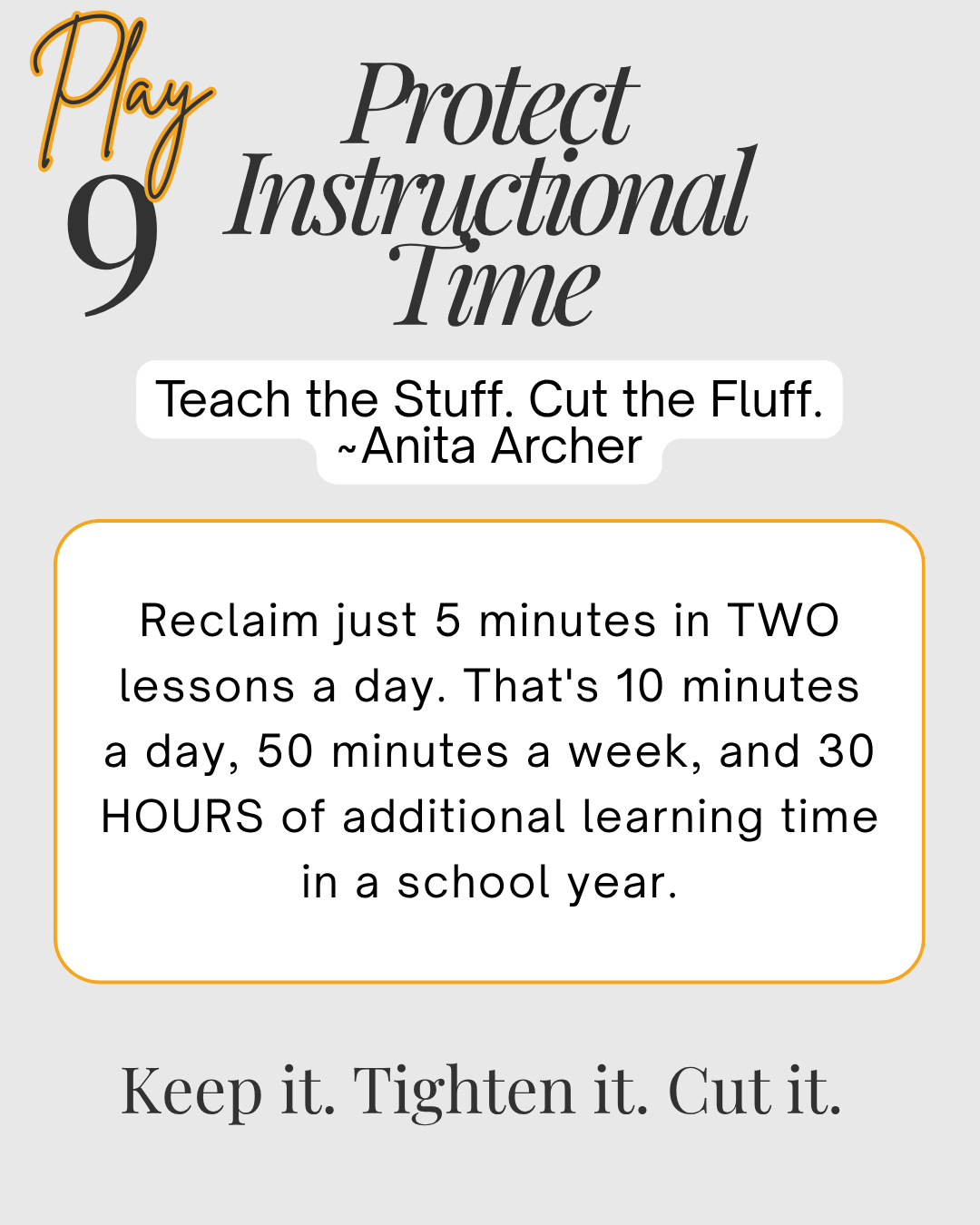
We don't always need more time. We need to make the most of the time we have.
Every minute students spend actively reading, writing, thinking, discussing, practicing, and receiving feedback is an opportunity to learn.
But instructional minutes disappear quickly: long transitions, passing out materials, elaborate activities, unnecessary worksheets, waiting for everyone to finish, lengthy directions, and tasks that keep students busy without moving learning forward.
The goal isn't to rush.
The goal is to protect the minutes that matter.
Why It Matters
Not all classroom time is equal.
Researchers distinguish between allocated time, the minutes scheduled for instruction, and the time students are actually engaged in academic learning. Decades of research have connected academic engaged time with achievement. Rosenshine's early work highlighted both content coverage and the minutes students spend directly engaged in academically relevant activities.
More recent research reinforces that idea. Kraft and Novicoff (2024) synthesized causal research on instructional time and found a generally positive effect of additional time on student achievement, while emphasizing that the impact depends on how effectively that time is converted into active learning time.
And Anita Archer and Charles Hughes put it simply as one of the foundations of explicit instruction: optimize engaged time/time on task. They emphasize that quantity alone isn't enough; the combination of the quantity and quality of instruction matters.
So before we say, "I don't have enough time!"
It's worth asking, "Where is my instructional time actually going?"
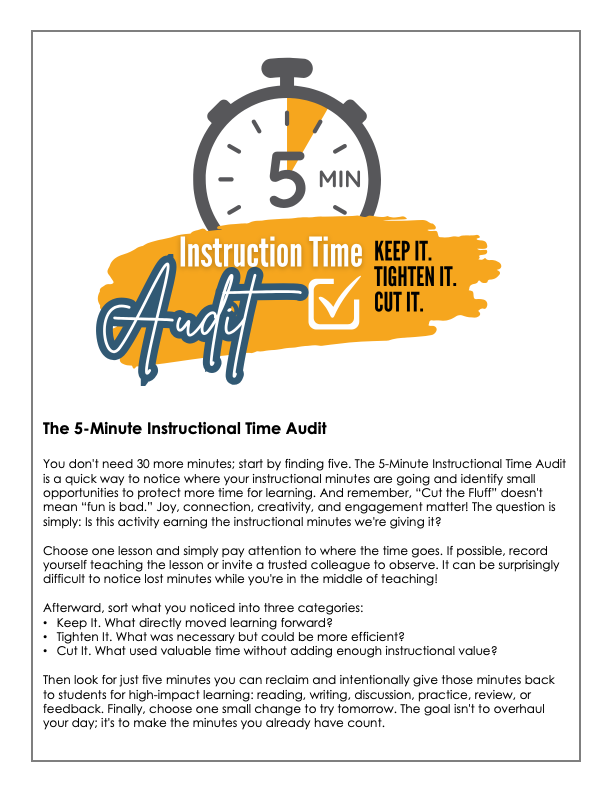
Try This Tomorrow: The 5-Minute Time Audit
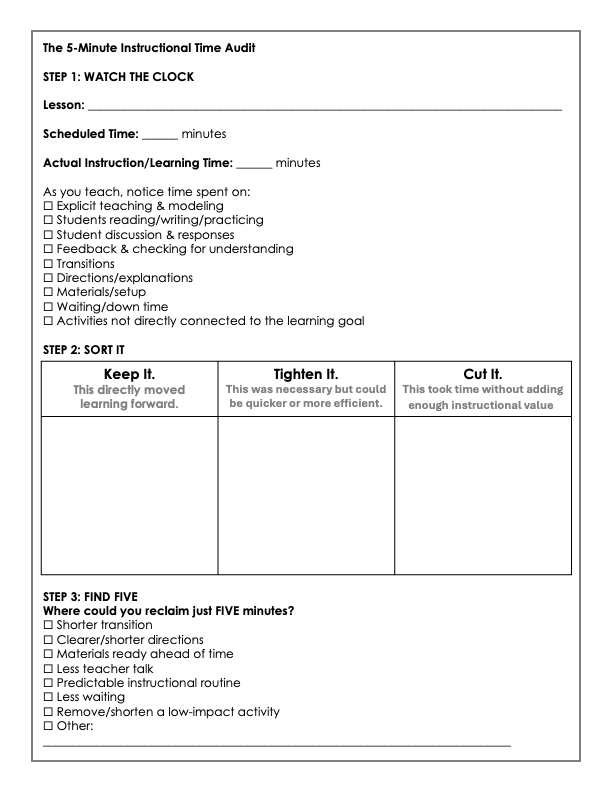
Choose one lesson tomorrow and pay attention to where the minutes go. At the end, ask yourself:
KEEP IT
What directly moved students toward today's learning goal?
TIGHTEN IT
What was necessary, but could be faster or more efficient?
CUT IT
What took time but added little instructional value?
Then ask the most important question:
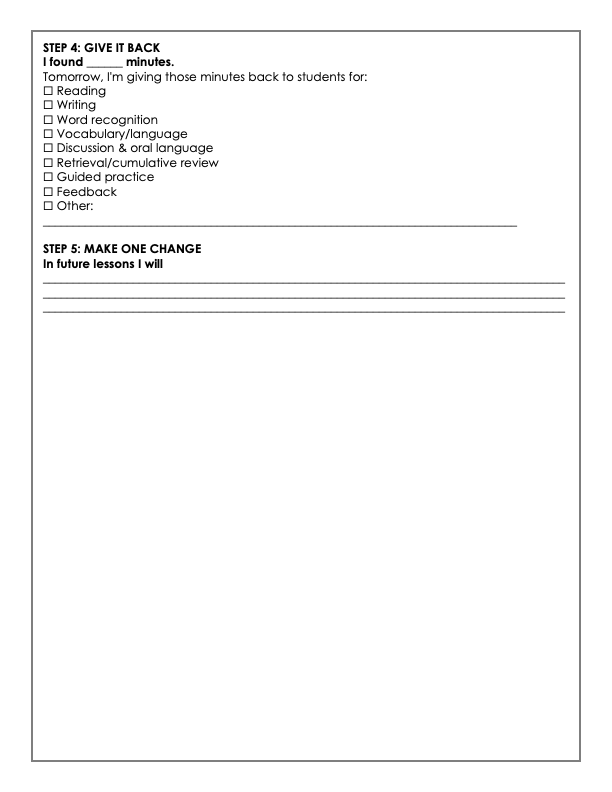
What could I give back to students?
Could you gain five minutes for:
reading connected text?
explicit word instruction?
vocabulary?
oral language?
sentence writing?
retrieval practice?
cumulative review?
student responses and discussion?
immediate feedback?
You're not trying to find another 30 minutes. Start by finding five.
5 Ways to Get Minutes Back
1. Tighten transitions.
Have materials ready. Establish routines. Give concise directions. Move quickly from one instructional task to the next.
2. Reduce teacher talk.
Explain clearly, model explicitly, and then get students responding. Rosenshine recommends asking many questions and checking responses from all students, not just a few volunteers.
3. Replace low-impact practice.
Ask: Does this activity actually practice what I need students to learn? A cute activity isn't automatically a bad activity, but if the decorating, cutting, gluing, coloring, or setup takes longer than the learning, reconsider it.
4. Build predictable instructional routines.
When students already know how to participate, less time is spent explaining the task and more time can be spent learning.
5. Keep the pace brisk; not rushed.
Archer and Hughes recommend a brisk (perky) instructional pace that maximizes instructional time and on-task behavior while still giving students adequate thinking and processing time.
Favorite Resource
The 5-Minute Instructional Time Audit
Research Corner
More time isn't automatically better. More time spent successfully engaged in high-quality learning is what we're after.
Research has long associated academic engaged time with student achievement (Rosenshine, 1978). Archer and Hughes identify optimizing engaged time and effectively covering academic content as foundational principles of explicit instruction. More recent causal research also finds that additional instructional time generally benefits achievement, but its impact depends on dosage, context, and critically, how the time is used (Kraft & Novicoff, 2024).
Archer, A. L., & Hughes, C. A. (2011).Explicit instruction: Effective and efficient teaching. Guilford Press.
Kraft, M. A., & Novicoff, S. (2024). Time in school: A conceptual framework, synthesis of the causal research, and empirical exploration. American Educational Research Journal, 61(4), 771–817. https://doi.org/10.3102/00028312241251857
Rosenshine, B. V. (1978). Academic engaged time, content covered, and direct instruction. Journal of Education, 160(3), 38–66. https://doi.org/10.1177/002205747816000304
Rosenshine, B. (2012). Principles of instruction: Research-based strategies that all teachers should know. American Educator, 36(1), 12–19, 39.
THE PLAY
Protect the time. Increase the learning.
Take a hard look at where your instructional minutes are going.
Keep what moves learning forward.
Tighten what takes too long.
Cut what doesn't earn its minutes.
Then give those minutes back to students for the things that matter most: Reading. Writing. Thinking. Talking. Practicing. Learning.
Play 10: Create Whole-Group Magic
Big Idea
Whole-group instruction doesn't mean passive learning.
Small-group instruction is powerful, but it's also resource and time-intensive. We simply can't provide every student with every lesson in a group of three or four.
That's why strong whole-group instruction matters so much.
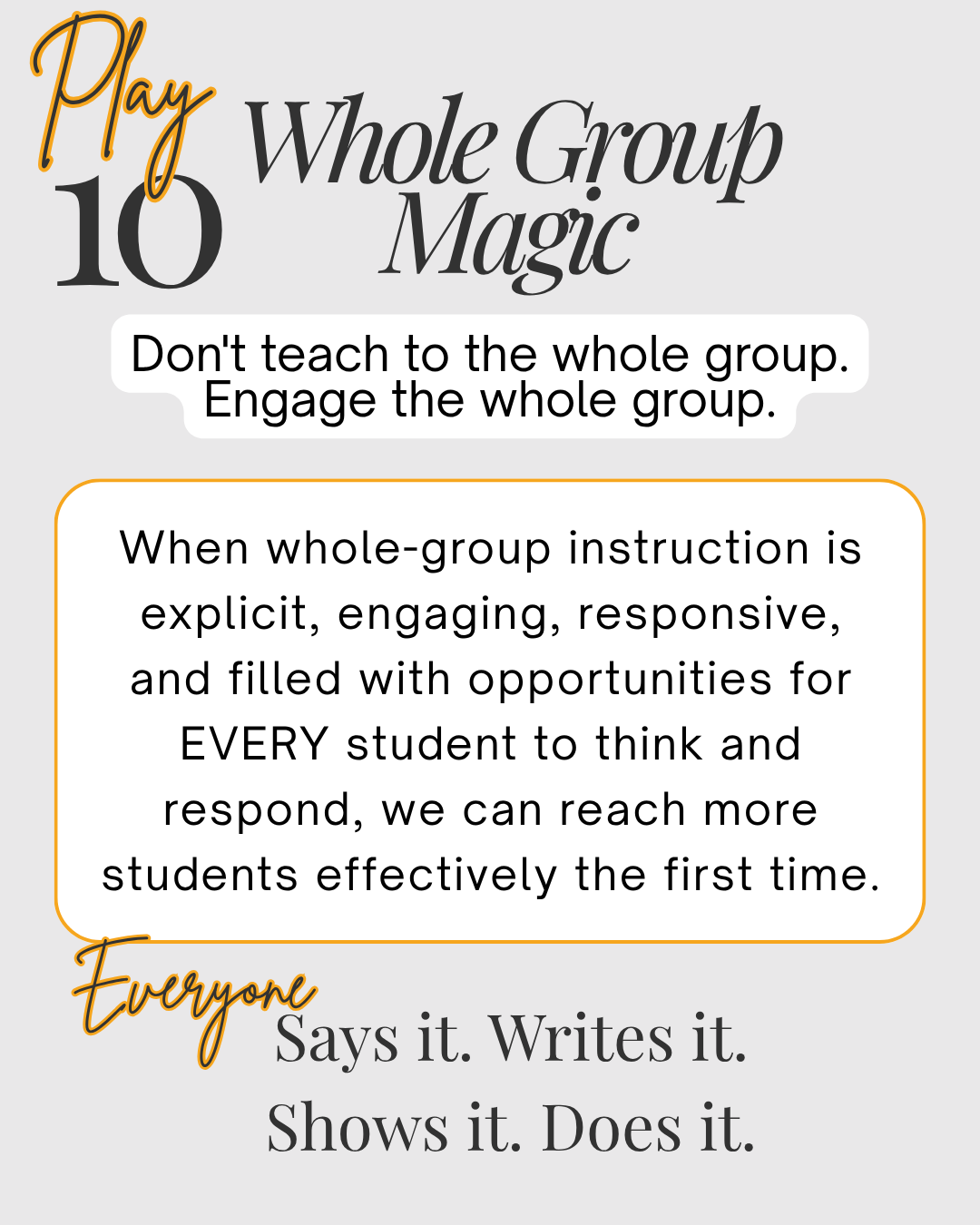
When whole-group instruction is explicit, engaging, responsive, and filled with opportunities for EVERY student to think and respond, we can reach more students effectively the first time.
The magic isn't really magic. It's well orchestrated instruction.
Why It Matters
Think about a classroom of 25 students. When the teacher works with five students in a small group, the other 20 are necessarily working without direct access to that teacher. Small groups can be incredibly valuable, but teacher time is a limited and expensive instructional resource.
Teacher time is valuable; use it wisely. Centers and independent practice absolutely have a place, but they should never replace the explicit instruction, guided practice, frequent responses, and immediate feedback students receive from a skilled teacher. Research with struggling readers has found stronger outcomes from teacher-directed instruction than less teacher-intensive approaches (Mathes et al., 2003). Before automatically sending students into rotations, ask: Could I teach this effectively to everyone first? Use whole-group instruction to maximize access to your expertise, then reserve precious small-group time for students who truly need additional intensity. Teach it well together. Then release students to practice independently.
But here's the catch: simply putting 25 students in front of one teacher doesn't guarantee great instruction. Whole-group instruction only works when the whole group is actually engaged in the learning!
Think about a classroom of 25 students. Ask a question and call on one student, and you get information about one student's thinking.
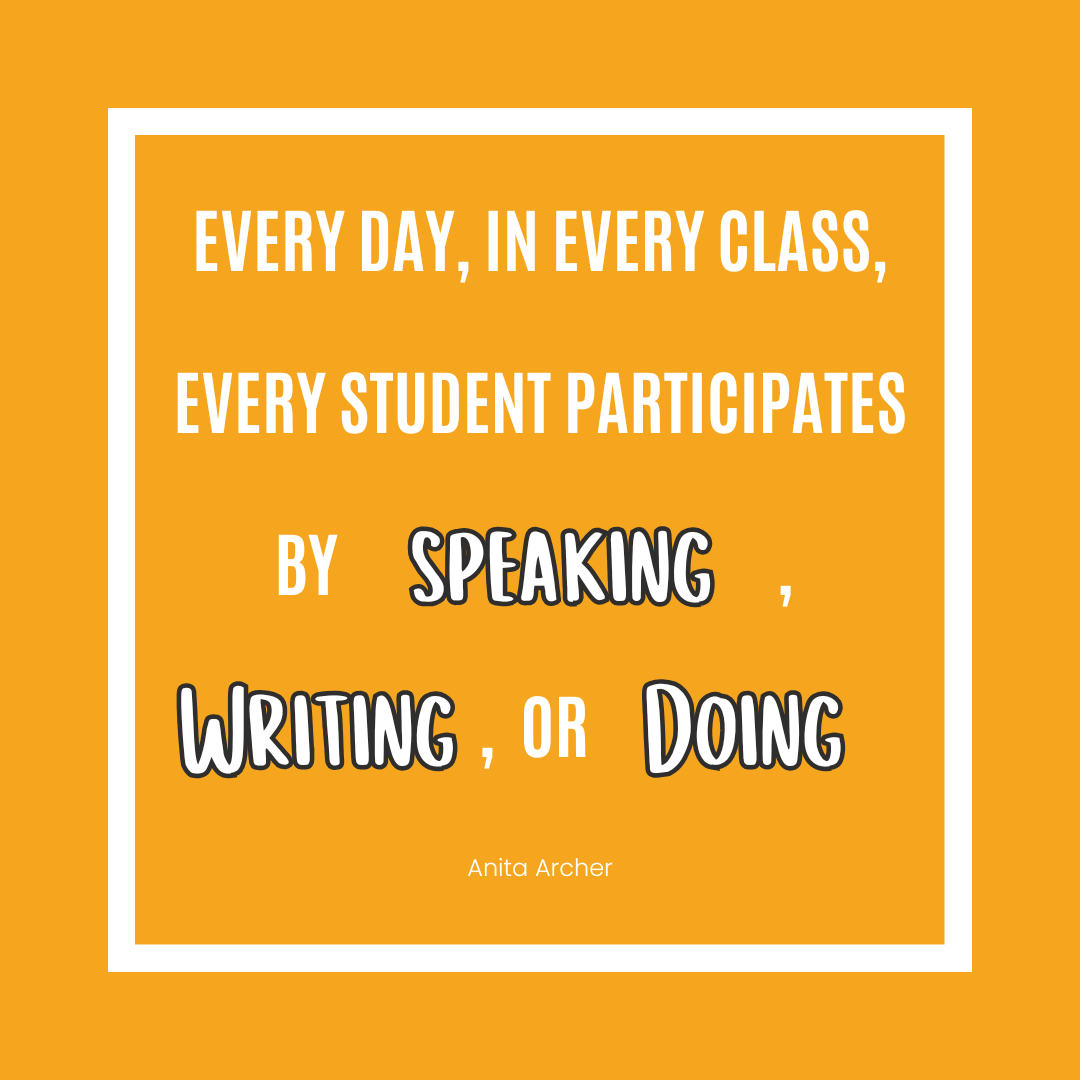
Ask all 25 students to say it, write it, show it, or do it, and suddenly you have information about the entire room. That's the difference between students watching instruction and students participating in instruction.
Rosenshine's research-based Principles of Instruction emphasize asking many questions, checking the responses of all students, providing high levels of active practice, guiding practice, and giving systematic feedback.
Archer and Hughes similarly identify frequent student responses as a critical element of explicit instruction. Frequent responses help students stay focused, practice new learning, elaborate on their thinking, and give teachers continuous information about whether students understand.
Whole group becomes powerful when the teacher isn't thinking, "How many students are listening?" but instead, "How many students are THINKING and RESPONDING?"
Try This Tomorrow:
Choose one whole-group lesson and challenge yourself to dramatically increase the number of times every student responds.
Students can:
SAY IT
Use choral responses, partner responses, sentence stems, or structured discussion.
WRITE IT
Use whiteboards, response cards, paper, or quick written responses.
SHOW IT
Use fingers, thumbs, response cards, gestures, or signals.
DO IT
Blend the word. Mark the morpheme. Point to the evidence. Sort the examples. Act out the vocabulary. Build the sentence.
Then LOOK. LISTEN. ADJUST. Don't collect responses simply for engagement. Use them as real-time formative assessment:
Who has it?
Who doesn't?
Do I move on?
Do I model again?
Do we need another example?
Who may need additional support later?
That's where the magic happens.
Favorite Resources:
Orchestrating Engagement in Whole Group Lessons Blog
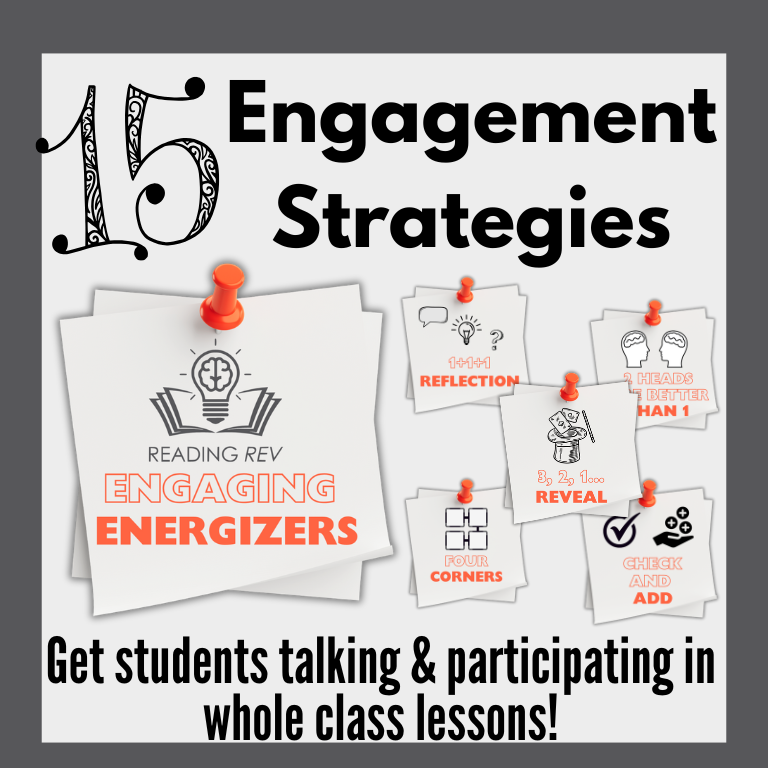
15 Engagement Energizers found in the VIP Vault or in the Playbook
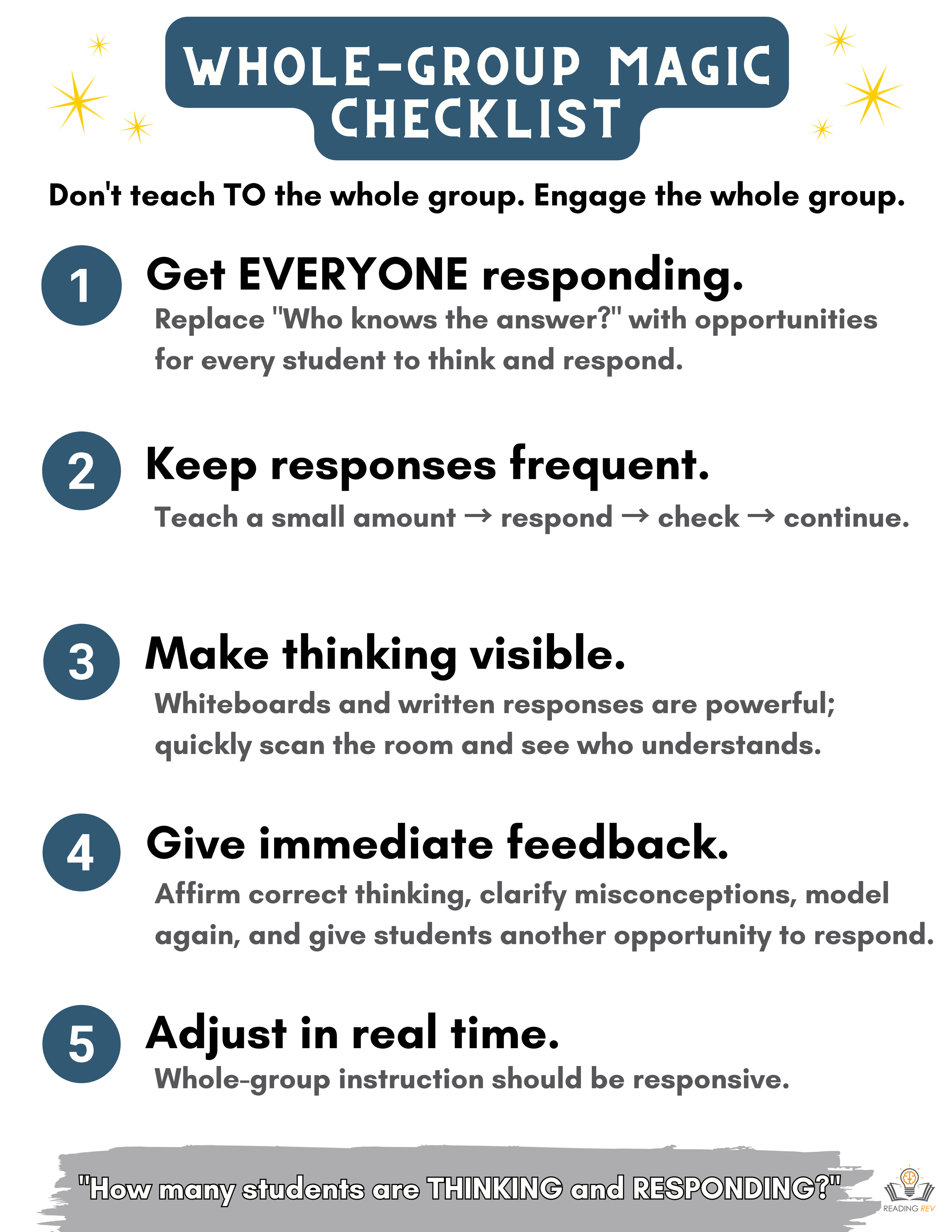
Whole-Group Magic Checklist
1. Get EVERYONE responding.
Replace "Who knows the answer?" with opportunities for every student to think and respond.
2. Keep responses frequent.
Don't talk for ten minutes and then check understanding. Teach a small amount → respond → check → continue.
3. Make thinking visible.
Whiteboards and written responses are especially powerful because you can quickly scan the room and see who understands.
4. Give immediate feedback.
Don't let errors sit. Affirm correct thinking, clarify misconceptions, model again, and give students another opportunity to respond.
5. Adjust in real time.
Whole-group instruction should be responsive. If half the room doesn't understand, that's not tomorrow's small group. That's today's whole-group reteach.
Rosenshine specifically describes effective teachers presenting material in small steps, providing practice after each step, asking many questions, checking responses, and reteaching when necessary.
Research Corner
The research behind whole-group magic isn't really about group size. It's about the quality of instruction happening within that group.
Rosenshine (2012) synthesized findings from cognitive science, research on effective classroom teachers, and research on cognitive supports. Among his principles were presenting new material in small steps, asking many questions, checking the responses of all students, guiding practice, obtaining a high success rate, and providing systematic review.
Archer and Hughes (2011) similarly emphasize frequent opportunities to respond as part of explicit instruction. When students respond frequently, teachers gain immediate information about learning while students receive more opportunities to practice and stay actively engaged.
Research on active student responding also supports frequent and varied opportunities to respond, with evidence connecting these practices to engagement, fluency, and academic performance.
The takeaway? Whole group doesn't have to mean one teacher talking while 25 students watch. It can mean 25 students thinking, responding, practicing, and getting feedback together.
Archer, A. L., & Hughes, C. A. (2011).Explicit instruction: Effective and efficient teaching. Guilford Press.
Rosenshine, B. (2012). Principles of instruction: Research-based strategies that all teachers should know. American Educator, 36(1), 12–19, 39.
Rosenshine's free Principles of Instruction article
Archer & Hughes's Explicit Instruction resources.
THE FINAL PLAY
Master the art of whole-group instruction. Teach explicitly. Keep everyone thinking. Require frequent responses. Check understanding. Give immediate feedback. Adjust when students need you to. Then use small-group instruction strategically for the students who need additional practice, scaffolding, or intensity.
Don't teach to the whole group. Engage the whole group.
Affiliate Disclosure: Some links in this post are affiliate links, which means Reading Rev may earn a small commission at no additional cost to you.