Most schools are working incredibly hard to improve literacy outcomes. Teachers are attending trainings, implementing new programs, analyzing data, and trying to meet the needs of every learner in front of them.
But despite all of that effort, many schools still struggle with one major issue:
Lack of instructional alignment.
One classroom may have strong phonics instruction, while another emphasizes comprehension discussions but lacks systematic foundational skills instruction. Some teachers may provide explicit modeling and cumulative review, while others are unintentionally relying on students to “discover” patterns independently.
The result?
Inconsistency across classrooms and inconsistent outcomes for students.
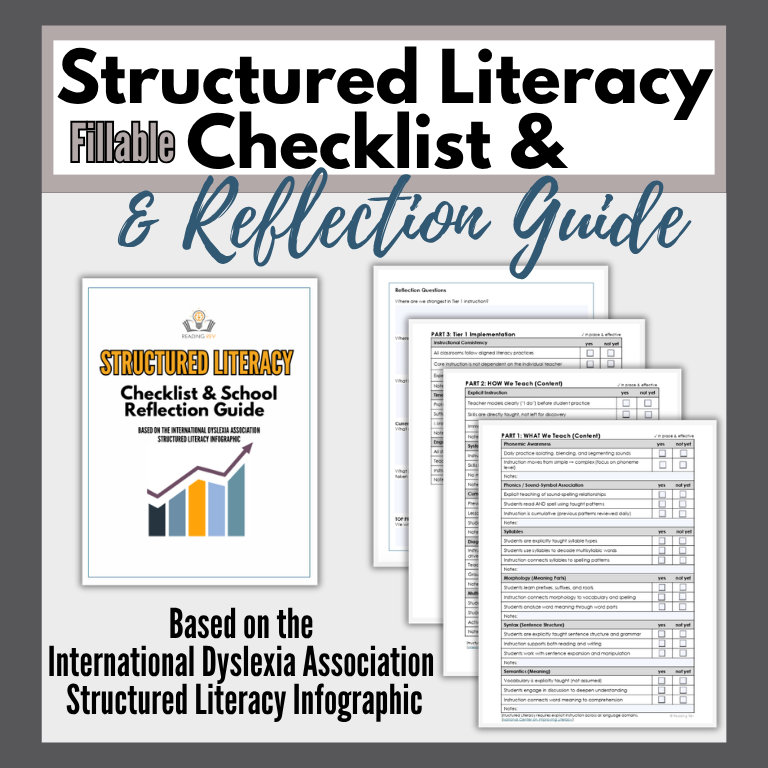
That’s why we created the fillable Structured Literacy Checklist & School Reflection Guide.
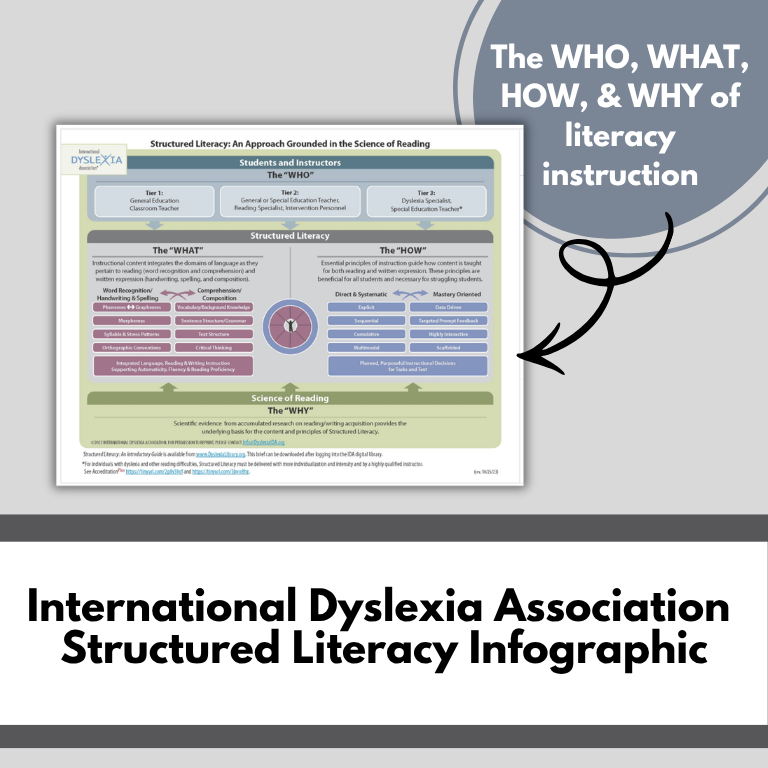
Built directly from the International Dyslexia Association’s Structured Literacy Infographic (International Dyslexia Association [IDA], 2025) this resource helps schools reflect on both:
What is being taught
How it is being taught
The checklist includes the core components of structured literacy, including:
Phonemic awareness
Phonics and sound-symbol association
Syllables
Morphology
Syntax
Semantics
It also addresses the instructional practices that make structured literacy effective, such as explicit instruction, systematic teaching, cumulative review, diagnostic teaching, and multisensory learning.
But here’s the most important part: This is not an evaluation tool.
It is designed to be a reflection and goal-setting tool that helps schools identify patterns, celebrate strengths, and determine the next highest-impact steps for improving Tier 1 instruction.
This is a reflection and goal setting tool; not an evaluation tool!
Teachers can first reflect individually:
What is already in place?
What still feels unclear?
Where is additional support needed?
Then teams can come together to discuss broader trends:
Where are we aligned?
Where are we inconsistent?
What is one area we should prioritize next?
Instead of trying to fix everything at once, schools can use the checklist to focus on one or two meaningful improvements that will strengthen literacy instruction school-wide.
Because sustainable change does not come from chasing every new initiative. It comes from building clarity, consistency, and strong instructional practices across every classroom.
You can access the fillable Structured Literacy Checklist & School Reflection Guide here.
This resource is also embedded into Reading Rev’s on-site professional development, where we guide schools through reflective conversations, instructional alignment, and actionable next steps for strengthening Tier 1 literacy instruction school-wide.
If your school is ready to move beyond “doing more” and start focusing on what matters most, this is a powerful place to begin.
International Dyslexia Association. (2025). Structured literacy education infographic. Dyslexia Library. https://dyslexialibrary.org/structured-literacy-education-infographic/