When Language Is the Barrier: Recognizing and Supporting DLD
Have you ever had a student who could read accurately and fluently but struggled to tell you what they just read? Or a student who had difficulty following directions, explaining their thinking, or finding just the right words? We often look at attention, behavior, or reading skills when students struggle with these tasks, but what if the missing piece is language?
October 16, 2026 is Developmental Language Disorder (DLD) Awareness Day. DLD affects approximately 1 in 14 children; that's potentially two students in a typical classroom (Norbury et al., 2016). While the name may be unfamiliar, the disorder isn't new. Throughout my teaching career I have heard it called Specific Language Impairment (SLI) or Expressive/Receptive Language Disorder. In 2017, an international panel of experts recommended the term DLD to create more consistent terminology and improve identification (Bishop et al., 2017). The updated definition also recognizes that language difficulties can coexist with other conditions, including dyslexia and ADHD. The disorder isn't new, but our understanding of it continues to evolve.
We spend a lot of time talking about phonics and word analysis in structured literacy, but language comprehension is equally important. Let's take a closer look at DLD, what it might look like in our classrooms, and, most importantly, what we can do to help.
What Is Developmental Language Disorder (DLD)?
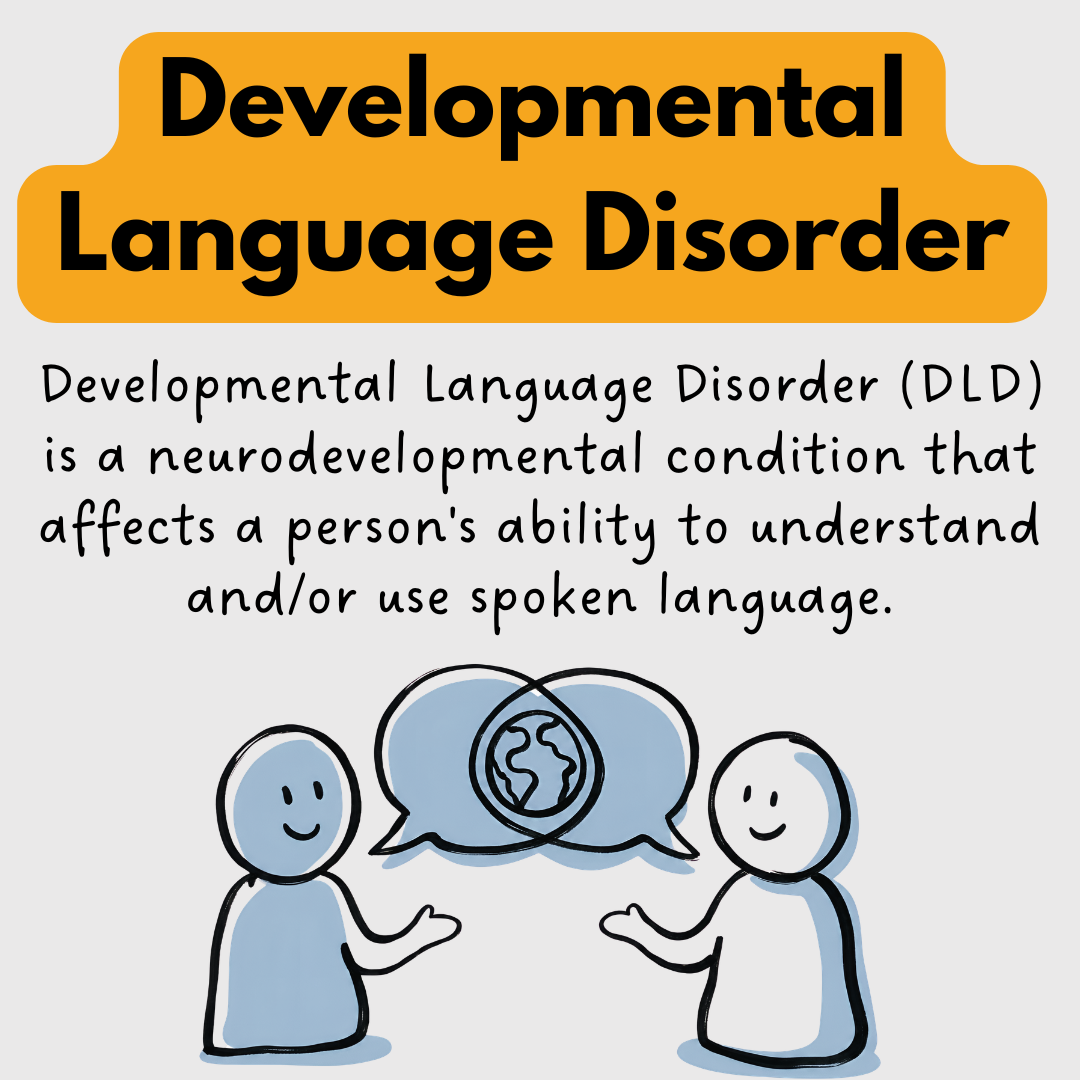
Developmental Language Disorder (DLD) is a neurodevelopmental disorder that affects a person's ability to understand and/or use language, but it goes beyond speaking! Language is how we make sense of what we hear, organize our thoughts, learn new vocabulary, understand sentences, and communicate our ideas. Students with DLD may struggle with any combination of these skills. Some have difficulty understanding what others say (receptive language), while others struggle to express their thoughts clearly (expressive language). Many experience challenges with both. DLD is not caused by low intelligence, poor parenting, or a lack of effort. These students have the ability to learn, but they often need more explicit instruction and targeted support to develop the language skills that so much of classroom learning depends on.
What Does DLD Look Like in the Classroom?
Here's where things get tricky. DLD isn't always easy to recognize! Some students are talkative, social, and seem to communicate just fine in everyday conversations. But when the language demands increase, the challenges become more apparent. Think about how much language we expect students to process throughout the school day. We ask them to follow multistep directions, learn new vocabulary, explain their reasoning, participate in discussions, and comprehend increasingly complex texts. For students with DLD, these everyday classroom tasks can be incredibly challenging.
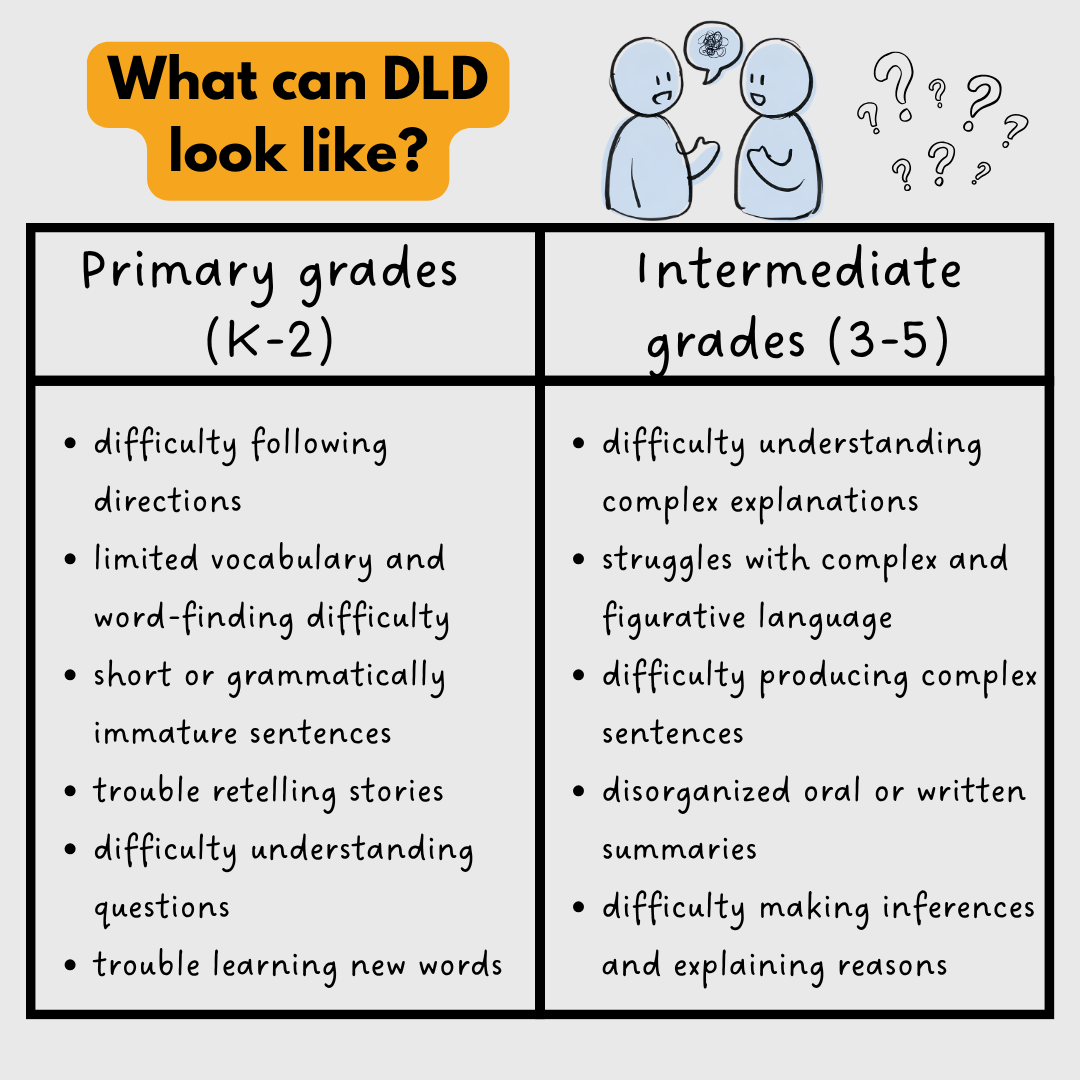
Here are some signs of DLD you might notice:
Difficulty following multistep directions or understanding complex questions
Trouble finding the right words or explaining ideas clearly
Limited vocabulary or difficulty learning and remembering new words
Short, incomplete, or grammatically incorrect sentences
Difficulty retelling stories, summarizing information, or organizing thoughts
Challenges understanding figurative language, inferences, or implied meanings
Difficulty comprehending text, even when decoding skills are relatively strong
How Does DLD Affect Reading and Writing?
This is where our understanding of structured literacy becomes so important! Think about Scarborough's Reading Rope. We spend a lot of time talking about the word recognition strands (phonological awareness, decoding, and sight recognition), but what about the language comprehension strands? Background knowledge, vocabulary, language structures, verbal reasoning, and literacy knowledge are equally important for skilled reading. Vocabulary, language structures, verbal reasoning, background knowledge, and literacy knowledge are all essential for skilled reading. Students with DLD may be able to decode every word on a page but still struggle to understand what they've read. These challenges don't stop at reading; writing requires students to retrieve vocabulary, construct sentences, organize ideas, and communicate their thinking. For students with DLD, these language demands can make communicating both orally and in writing very difficult. While dyslexia primarily affects accurate and/or fluent word reading and spelling, DLD affects understanding and using language. A student can have one, the other, or both. That's why looking at both word recognition and language comprehension is so important!
Looking Deeper: What Are We Missing?
A few weeks ago, I attended a session at Reading in the Rockies called Teasing Out Hidden DLD in School-Aged Children, presented by Morgan Lipton and Anne Whitney. One statement they said really stuck with me, "What is being missed? We need to look deeply and comprehensively at oral language in older students who have had good instruction, but continue to struggle." They shared a simple but powerful way to get a closer look at a student's language. Collect a three-minute oral language sample. Ask an open-ended question, such as "Where have you always wanted to visit?" Record the student's response without providing prompts or assistance, then transcribe exactly what they say, including pauses, fillers, and grammatical errors. Using Bloom and Lahey's Model of Language (Bloom & Lahey, 1978), we can examine three areas: Form (how language is structured), Content (what the student communicates), and Use (how language serves a communicative purpose). This brief observation can reveal patterns we might otherwise miss. While collecting a language sample can help us notice potential concerns, interpreting those patterns takes training and expertise. Collaborate with your school's speech-language pathologist to determine whether a comprehensive language evaluation is warranted.
What Can Teachers Do to Support Students with DLD?
Here's some good news: many of the instructional practices we know are effective for developing language and literacy in all kids also benefit students with DLD. However, these students often need more explicit instruction, additional practice, and targeted language intervention. Simply exposing students to rich language isn't enough. We need to intentionally teach the language skills they are struggling to develop.
Download RADLD.ORG’s 8 Simple Actions- Effective Teaching and Learning Framework for Students with DLD
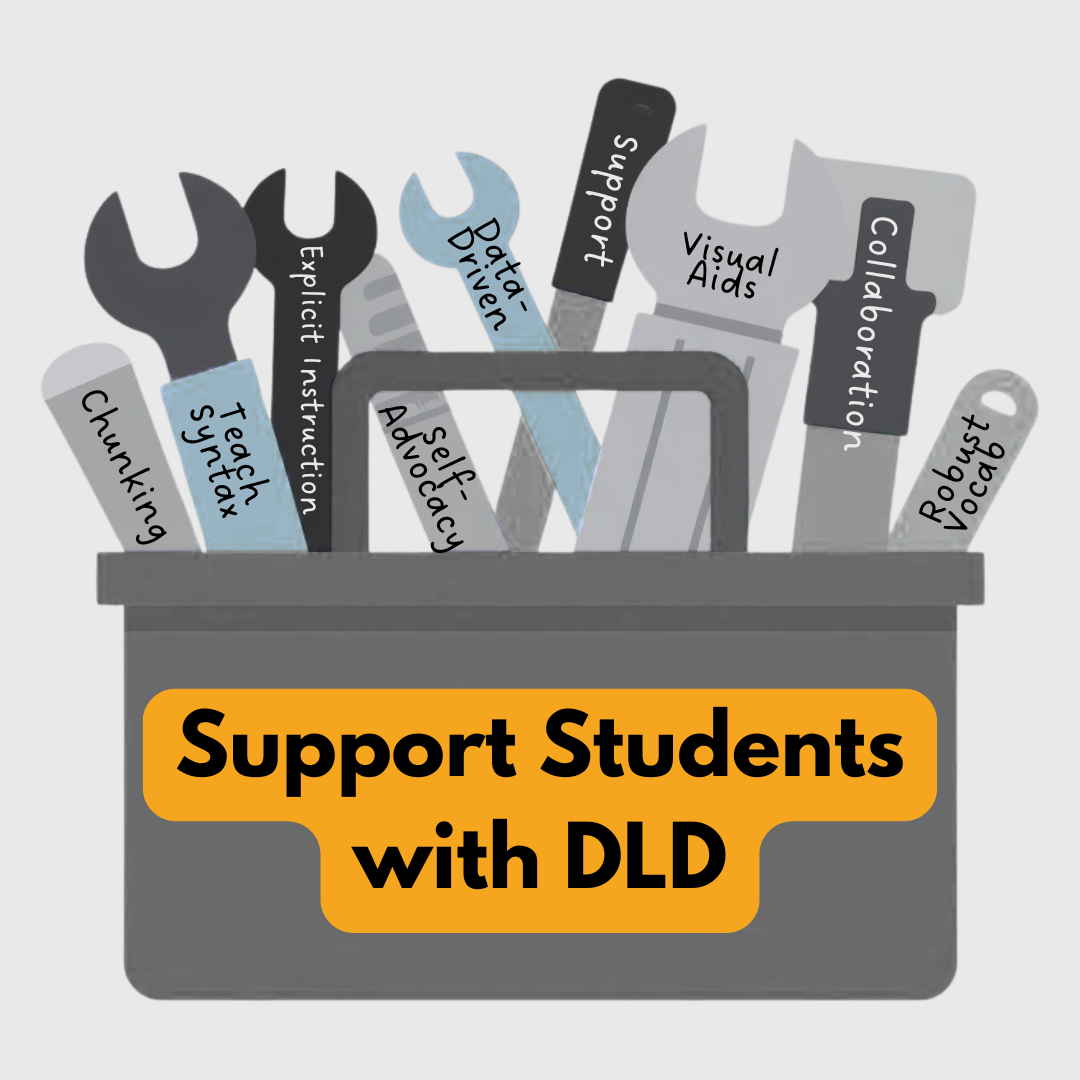
Here are some ways you can support students with DLD in the classroom:
Explicitly teach vocabulary. Don't assume students will learn new words simply by hearing or reading them. Teach word meanings, provide examples and nonexamples, and revisit words frequently in different contexts.
Teach sentence structure (syntax). Model how sentences work. Practice expanding, combining, and deconstructing sentences. Help students understand how word order and grammatical structures affect meaning.
Make morphology part of your instruction. Teach prefixes, suffixes, and roots to help students understand how words are built and how their meanings change. Include grammatical endings, such as -ed and -s, that communicate important information.
Build oral language opportunities into every lesson. Give students structured opportunities to talk, explain, describe, compare, and justify their thinking. Use sentence frames and modeling when needed.
Use visuals and chunk directions. Pair spoken instructions with written directions, pictures, or demonstrations. Break complex directions into manageable steps and check for understanding.
Provide additional processing time. Students may need extra time to understand a question, retrieve vocabulary, and formulate a response. Resist the urge to jump in and answer for them!
Explicitly teach comprehension and narrative skills. Model how to connect ideas, make inferences, retell events, and summarize information. Graphic organizers and story structures can provide helpful scaffolds.
If you're noticing persistent language difficulties, start documenting what you're seeing. Talk with your school's speech-language pathologist and intervention team. Look for patterns across speaking, listening, reading, and writing. The goal isn't for teachers to diagnose DLD, but to recognize when a student needs a closer look. Classroom accommodations help students access instruction, but they don't replace intervention. Students with DLD may need individualized language intervention from a speech-language pathologist (SLP). Teachers and SLPs working together can make a tremendous difference!
Want to Learn More About DLD?
If DLD is new to you, you're not alone! The good news is that awareness is growing, and there are some excellent resources available to help educators better understand this often-overlooked disorder.
Here are a few places to start:
RADLD — Raising Awareness of Developmental Language Disorder: This international awareness initiative is a fantastic starting point! You'll find fact sheets, videos, classroom resources, and materials to share with families. They also organize DLD Awareness Day each October.
RADLD Teacher Kit: Looking for something practical? This collection includes materials designed specifically to help teachers raise awareness and better understand DLD.
National Institute on Deafness and Other Communication Disorders (NIDCD): A research-based overview of DLD, including common characteristics, diagnosis, treatment, and current research.
International Dyslexia Association (IDA) — Developmental Language Disorder and Dyslexia: This fact sheet explores the relationship between DLD and dyslexia, including how the two disorders overlap and differ. It's an especially valuable resource for educators working to understand the connections between oral language, word recognition, and reading comprehension.
P.S. Tales from a Real Classroom
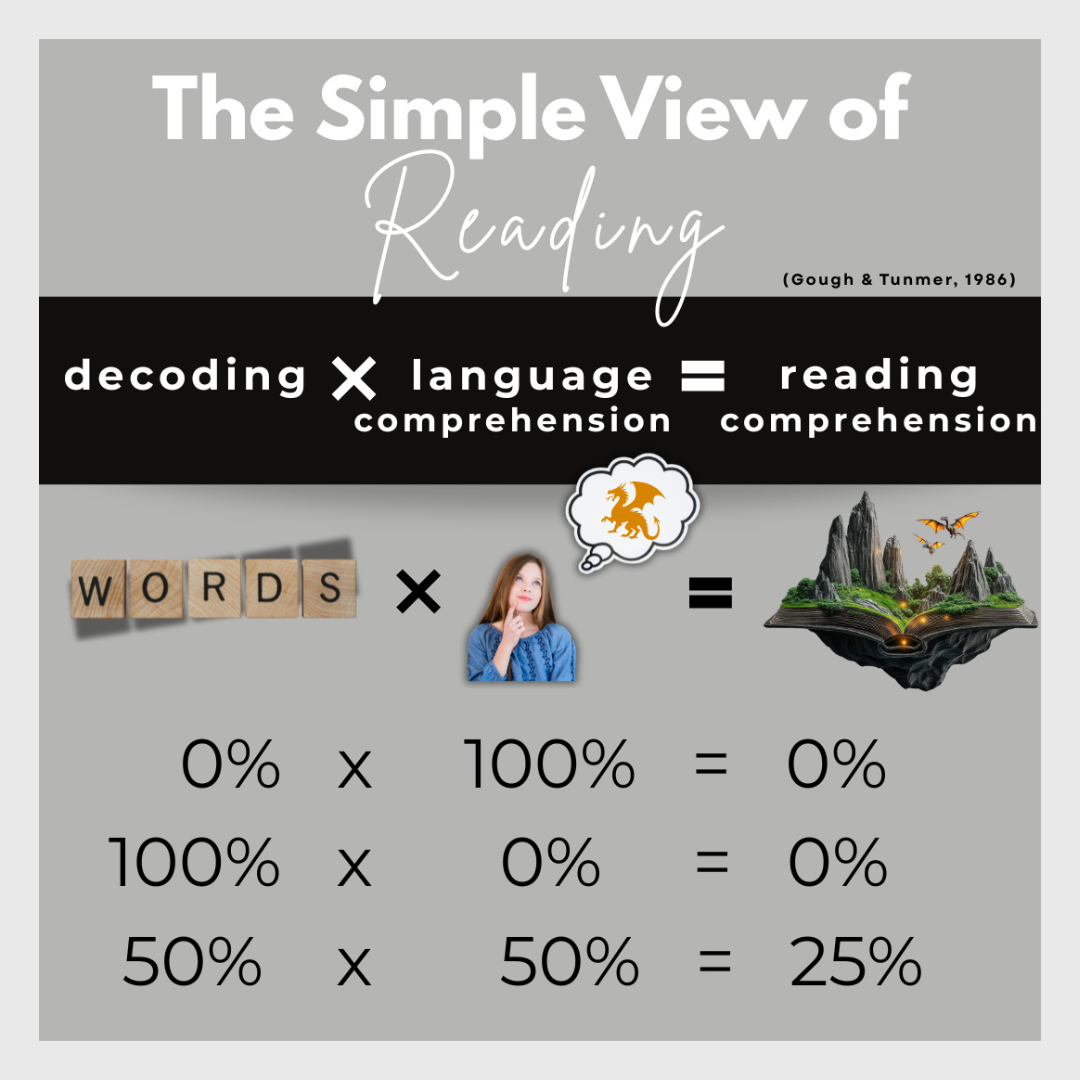
Several years ago, I had a group of intermediate students who were making great progress with decoding and fluency, but their reading comprehension was impacting their ability in the classroom. Their teachers were frustrated. We knew we were missing something. I went back to the Simple View of Reading and realized I needed to spend our intervention time on the language comprehension side of things. I documented my learning (and a whole lot of trial and error!) in a four-part blog series called The Language Comprehension Side of Things. We explored background knowledge, vocabulary, syntax and sentence structure, and visualization.
To be clear, these students weren't necessarily diagnosed with DLD, and this series isn't intended to be a DLD intervention guide. However, many of the language skills we worked to strengthen are the same skills that can be challenging for students with DLD. The series offers a real look at how I approached language comprehension instruction with actual students, including what I tried, what I learned, and what I would do differently. It's a great reminder that when students aren't making the progress we expect, sometimes we need to drill deeper to figure out what's missing.
You can revisit the four parts in the Language Comprehension Side of Things Series here:
1- Building Background Knowledge
2- Vocabulary
One Final Thought
Language is the foundation of learning. When students struggle to understand or express language, the effects can show up in nearly every part of their school day. The more we understand about DLD, the better equipped we are to recognize these challenges and respond with intentional instruction and meaningful support.
We can't address a learning need we don't recognize. And sometimes, understanding what's behind a student's struggles is the first step toward changing their learning experience.
Bishop, D. V. M., Snowling, M. J., Thompson, P. A., Greenhalgh, T., & CATALISE-2 Consortium. (2017). Phase 2 of CATALISE: A multinational and multidisciplinary Delphi consensus study of problems with language development: Terminology. Journal of Child Psychology and Psychiatry, 58(10), 1068–1080. https://doi.org/10.1111/jcpp.12721
Bloom, L., & Lahey, M. (1978). Language development and language disorders. Wiley.
International Dyslexia Association. (n.d.). Developmental language disorder [Fact sheet]. https://dyslexialibrary.org/wp-content/uploads/file-manager/public/18393/dld-fact-sheet.pdf
Lipton, M., & Whitney, A. (2026, October 2). Teasing out hidden DLD in school-aged children [Conference session]. Reading in the Rockies, Colorado Springs, CO, United States.
National Institute on Deafness and Other Communication Disorders. (n.d.). Developmental language disorder. National Institutes of Health. https://www.nidcd.nih.gov/health/developmental-language-disorder
Norbury, C. F., Gooch, D., Wray, C., Baird, G., Charman, T., Simonoff, E., Vamvakas, G., & Pickles, A. (2016). The impact of nonverbal ability on prevalence and clinical presentation of language disorder: Evidence from a population study. Journal of Child Psychology and Psychiatry, 57(11), 1247–1257. https://doi.org/10.1111/jcpp.12573
Raising Awareness of Developmental Language Disorder. (n.d.-a). 8 simple actions: Effective teaching and learning framework for students with DLD. https://radld.org/dld-education-strategies/
Raising Awareness of Developmental Language Disorder. (n.d.-b). DLD teacher kit. https://radld.org/dld-awareness-day/resources-media-ideas/teacher-kit/
Raising Awareness of Developmental Language Disorder. (n.d.-c). Raising awareness of developmental language disorder. https://radld.org/