
Why “Turn and Talk” Isn’t Enough—and What to Do Instead
Welcome to our Rooted in Research series—where we do the legwork of breaking down the research and turn it into practical, classroom-ready strategies you can use right away.
Rooted in Research: Elevating Academic Talk
If you’ve been in a classroom for more than five minutes, you’ve probably heard or said,“Turn and talk to your partner.”
It’s one of the most common instructional moves we use, and there are many positive aspects of this teacher-tool. The research consistently points us in the same direction: learning is social. Collaborative learning is embedded within several high-leverage practices (McLeskey et al., 2017) showing that student interaction is not an add-on, but is essential to effective instruction. Studies on cooperative learning show that when students engage in structured peer discussion, participation increases, confidence grows, and classrooms become more inclusive learning environments (Jenkins et al., 2003).
But here’s the truth: Not all student talk leads to learning.
In fact, without structure, “turn and talk” often results in:
One student doing most of the talking
Off-task conversations
Surface-level responses
Students unsure how to begin
And yet…we keep using it. So the question becomes: How do we move from students talking…to students thinking and learning?
What the Research Says About Student Talk
The idea that students learn through discussion isn’t just best practice, it’s backed by a strong body of research. Studies on think–pair–share and structured peer discussion consistently show that when students are given time to think and talk with a partner:
Participation increases significantly (not with just a few students, but all students)
Students give longer, more detailed responses
Confidence improves, especially for reluctant speakers (Sampsel, 2013)
Comprehension deepens through verbal processing
Research also highlights something important: The “think” and “pair” phases are where most of the learning happens…not the share.
When students have time to process their thinking and rehearse it with a peer, they are more likely to:
Clarify ideas
Use academic language
Revise their thinking in real time
Collaborative learning research (EEF, 2021) further supports this, showing that structured peer interaction has a positive impact on student outcomes, particularly when talk is purposeful and guided.
The Problem: We’re Using the Strategy…But Missing the Structure
Here’s the disconnect:
We are using turn and talk as an engagement strategy…but not as an instructional tool. As outlined in our Elevated Academic Talk Toolkit, the issue isn’t the strategy itself, it’s the lack of structure. Without intentional design, students don’t automatically:
Build on each other’s ideas
Ask meaningful questions
Use evidence
Engage in productive disagreement
Because here’s the reality, students are not naturally equipped with the language of academic discussion; they must be taught how to talk.
The Shift: From Turn & Talk → Structured Academic Talk
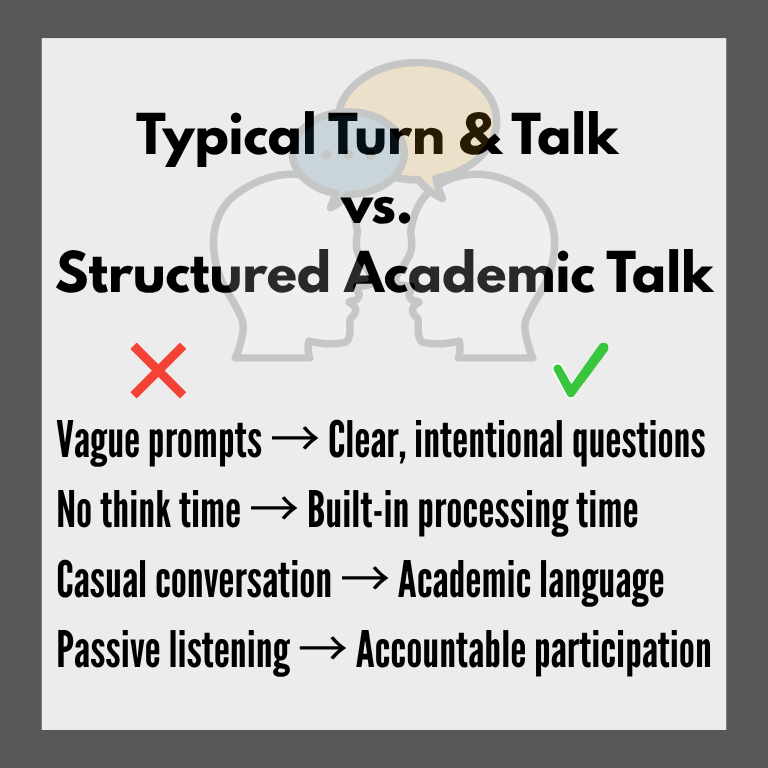
So what does this look like in practice? It begins with a simple but powerful shift. Instead of asking students to “turn and talk” intentionally guide their academic conversations. In the classroom, this means moving beyond vague prompts to clear, purposeful questions that guide thinking. It includes building in time for students to process their ideas before speaking, rather than expecting immediate responses. Conversations shift from casual exchanges to the use of academic language, and listening becomes active and accountable. Instead of simply talking, students are expected to engage, respond, and build on one another’s ideas! This will transform partner talk into meaningful, thinking-driven discussion.
The 4-Part Structure That Changes Everything
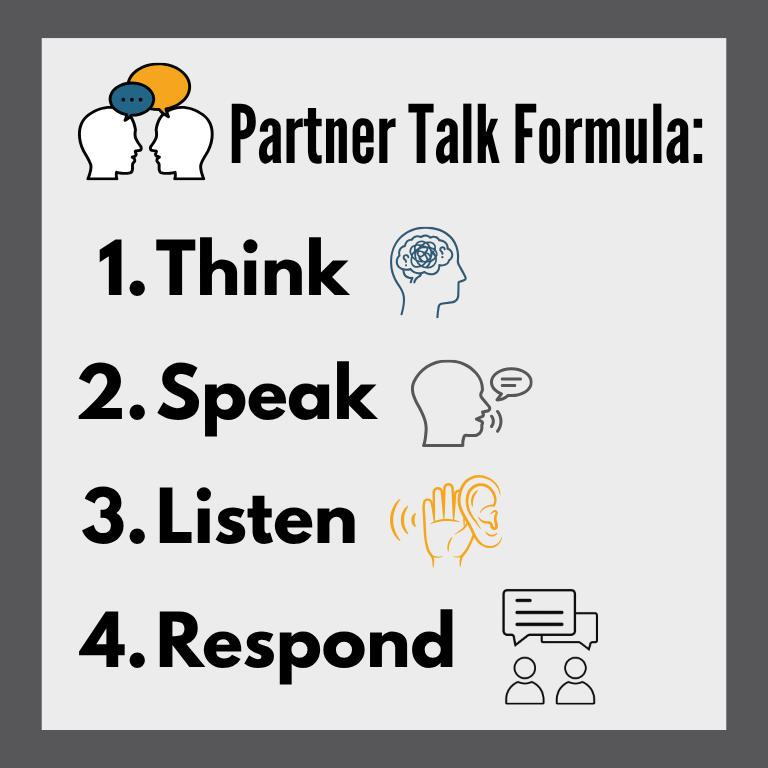
One of the most impactful upgrades is giving students a clear structure or formula for partner talk:
THINK (Silent) Students prepare their idea (5–10 seconds minimum)
SPEAK (Partner A) Share thinking using a sentence stem + evidence
LISTEN (Partner B) Actively listen and prepare to respond
RESPOND Build, agree, disagree, or extend thinking
Then switch roles.
This structure may feel simple, but it fundamentally changes the quality of student interaction.
While the structure Think, Speak, Listen, Respond may feel simple, it is grounded in decades of research on how students learn. Research on wait time (Rowe) highlights the importance of giving students time to think before responding. Think–pair–share (Lyman) and collaborative learning research (EEF) show that verbalizing ideas strengthens understanding and increases participation. Work on accountable talk (Michaels & Resnick) emphasizes the role of listening and responding in building knowledge, while Vygotsky’s theory of social learning reinforces that understanding develops through interaction with others.
Together, this research supports a clear conclusion: learning is not just about answering questions; it is about thinking, talking, listening, and responding.
Teaching Students HOW to Talk
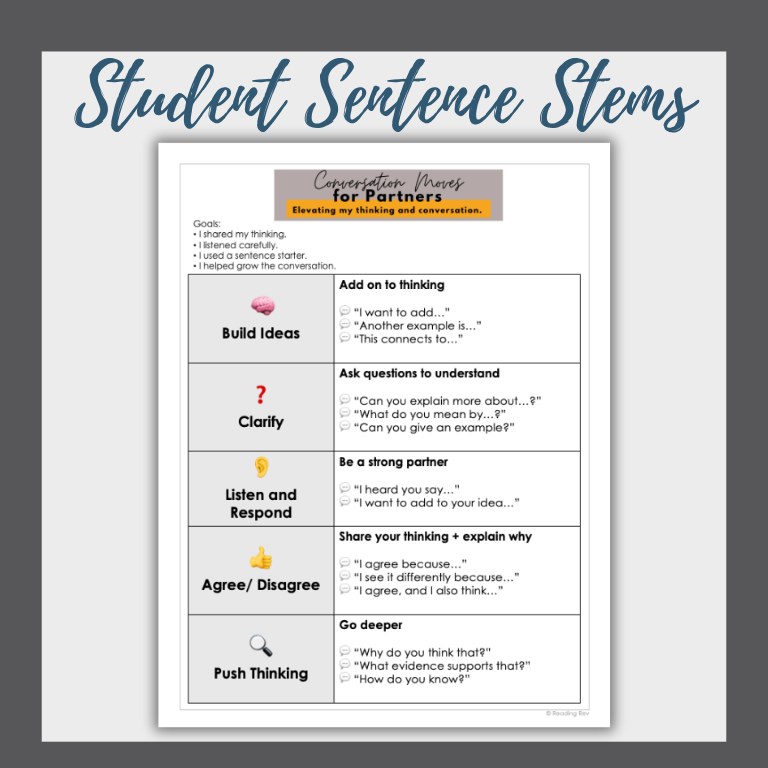
If we want better conversations, we have to teach students the language to get there. That’s where conversation moves come in. Instead of hoping students will “just talk,” we explicitly model and practice by giving them discussion and sentence stems like, “I want to add…” “I agree because…” “Can you explain more about…?” “What evidence supports that?”
These sentence stems do more than support participation, they help students build ideas, clarify thinking, use reasoning, engage in academic discourse.
Over time, this shifts talk from sharing answers to growing thinking!
These sentence stems do more than support participation, they help students build ideas, clarify thinking, use reasoning, engage in academic discourse.
The Hidden Lever: Better Prompts
If there’s one place teachers can make an immediate impact, it’s the level of the prompt determines the level of student thinking.
Too often, we ask basic questions like,“What happened?” or “Who is the main character?” These questions aren’t wrong, but they don’t require thinking.
When we upgrade prompts, everything changes:
“Why did that happen?”
“How do you know?”
“Do you agree? Why?”
“What evidence supports your thinking?”
Now students must analyze, justify, connect ideas, and consider multiple perspectives. This is where academic talk becomes academic thinking and discussion.
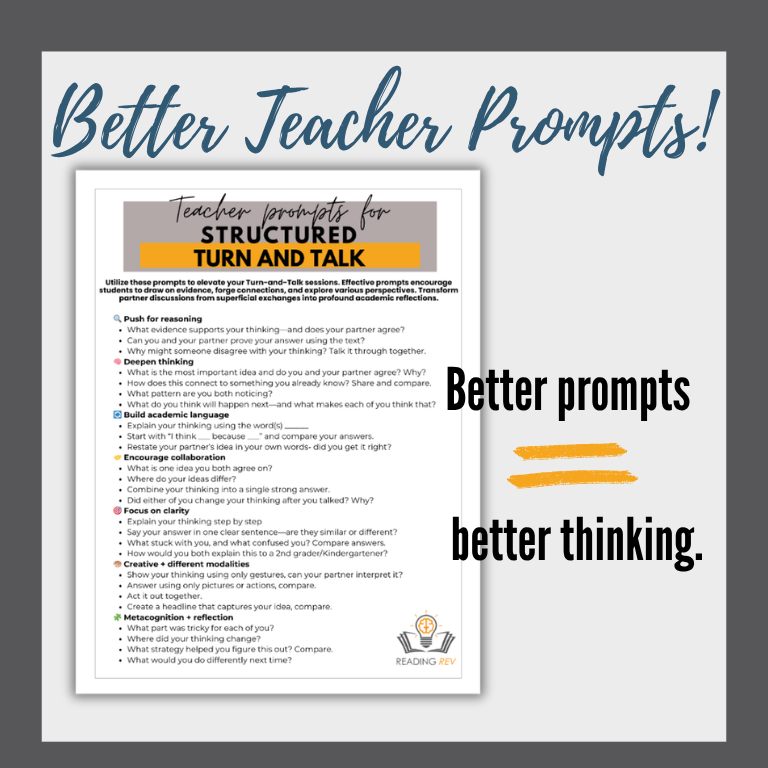
If there’s one place teachers can make an immediate impact, it’s the level of the prompt determines the level of student thinking.
Accountability: The Game-Changer
Another key finding from both research and practice is talk only works if everyone is accountable. Simple shifts make a big difference:
Assign roles (Speaker / Listener)
Give equal talk time
Ask students to share their partner’s thinking
This one move alone increases listening, equity, and depth of discussion.
So What Does This Mean for Your Classroom?
It doesn’t mean abandoning turn and talk. It means elevating it.
Start small:
Add think time
Provide one sentence stem
Ask students to explain why
Because when we move from talking to participate to talking to think, we unlock one of the most powerful tools in our classrooms. The research consistently points us in the same direction. As the Education Endowment Foundation states, “most of the positive collaborative approaches include the promotion of talk and interaction between learners.” In other words, talk is not just something we add to a lesson; it’s something we design for. And when we do it well, it becomes one of the most powerful tools for learning in our classrooms.


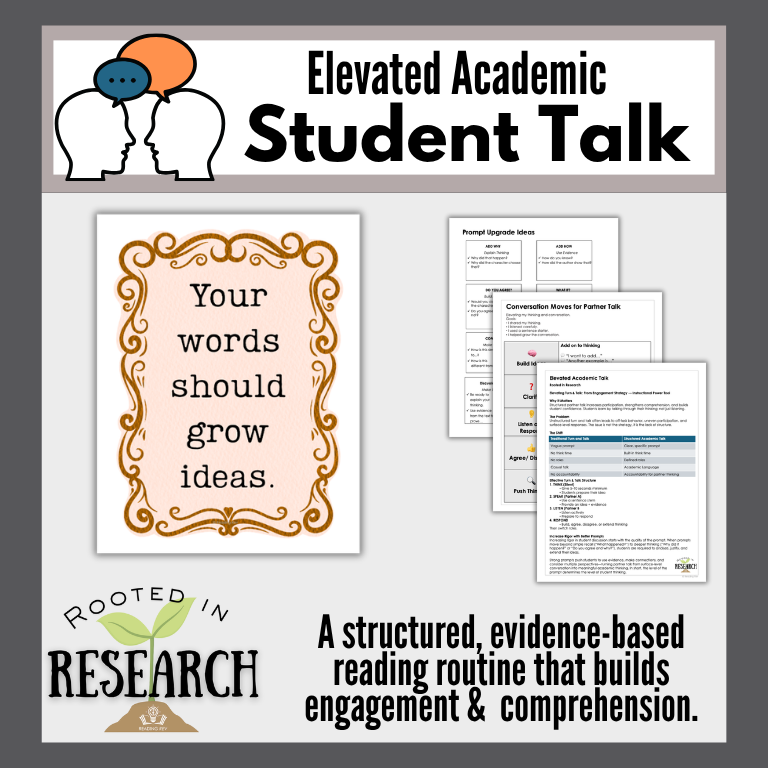
Find this Rooted in Research Resource in the VIP Library or here.
This work is grounded in research on collaborative learning, structured discussion, and think–pair–share strategies.
Further reading and research links can be found inside this Rooted in Research Resource as well as:
Sampsel (2013) – Think-pair-share & student confidence
Education Endowment Foundation (2021) – Collaborative learning
Reading Rockets – Think-pair-share overview
Edutopia (2023) – Turn & talk strategies